Suggested stay: 6 to 8 nights, one or two bases
Best months: May to June · September to mid-October
Country: Italy
Zones: Valle d’Itria · Adriatic coast · Salento · Ionian coast · Gargano
Puglia Luxury Travel: The Masseria, the Baroque and Two Different Seas
Puglia luxury travel is organized around a building type rather than a city. The masseria — a fortified farm turned into a place to stay — sets the rhythm of the week, and the heel of Italy holds roughly eight hundred kilometers of coastline on two seas that behave nothing alike.
At Escape Xperts, we plan the region by farm, by sea and by stone. Where Tuscany asks which valley, Puglia asks which coast and which century of architecture the traveler wants outside the window.
The Masseria: A Fortified Farm That Became a Hotel
A masseria began as an agricultural estate built to defend itself. Thick whitewashed walls, an enclosed courtyard, watchtowers at the corners and, inside, the olive press, the stables and the family quarters arranged around a single protected center.
That structure is what distinguishes it from a country hotel elsewhere in Italy. The rooms occupy former working spaces, the courtyard remains the social heart, and the surrounding olive groves are frequently still in production rather than decorative.
Because of this, a masseria stay carries a different texture. The oil at breakfast comes from the trees visible from the terrace, the kitchen garden supplies the restaurant, and the scale is small enough that the property never feels like a resort.
Masseria Torre Maizza near Savelletri holds the classic version: a low white complex with a golf course, a beach club on the Adriatic and rooms built into the original farm structure. Borgo Egnazia nearby takes the opposite approach, reconstructing an entire Puglian village at scale, with the space and the facilities that larger groups and families need.
Therefore, the first decision in Puglia luxury travel is intimacy against amenity. A working masseria of twenty rooms and a village-scale property offer very different weeks, and both are legitimate answers.
Valle d’Itria: White Towns and the Trulli Country
The Valle d’Itria is the interior plateau between Bari and Brindisi, and it is the strangest landscape in southern Italy. Dry stone walls divide the fields, ancient olive trees stand in twisted forms, and conical stone roofs appear across the valley floor.
Those roofs are the trulli, mortarless limestone structures built to be dismantled quickly. Alberobello holds them in their densest concentration, a full town of them, which is precisely why it fills with coaches by mid-morning and empties again by five.
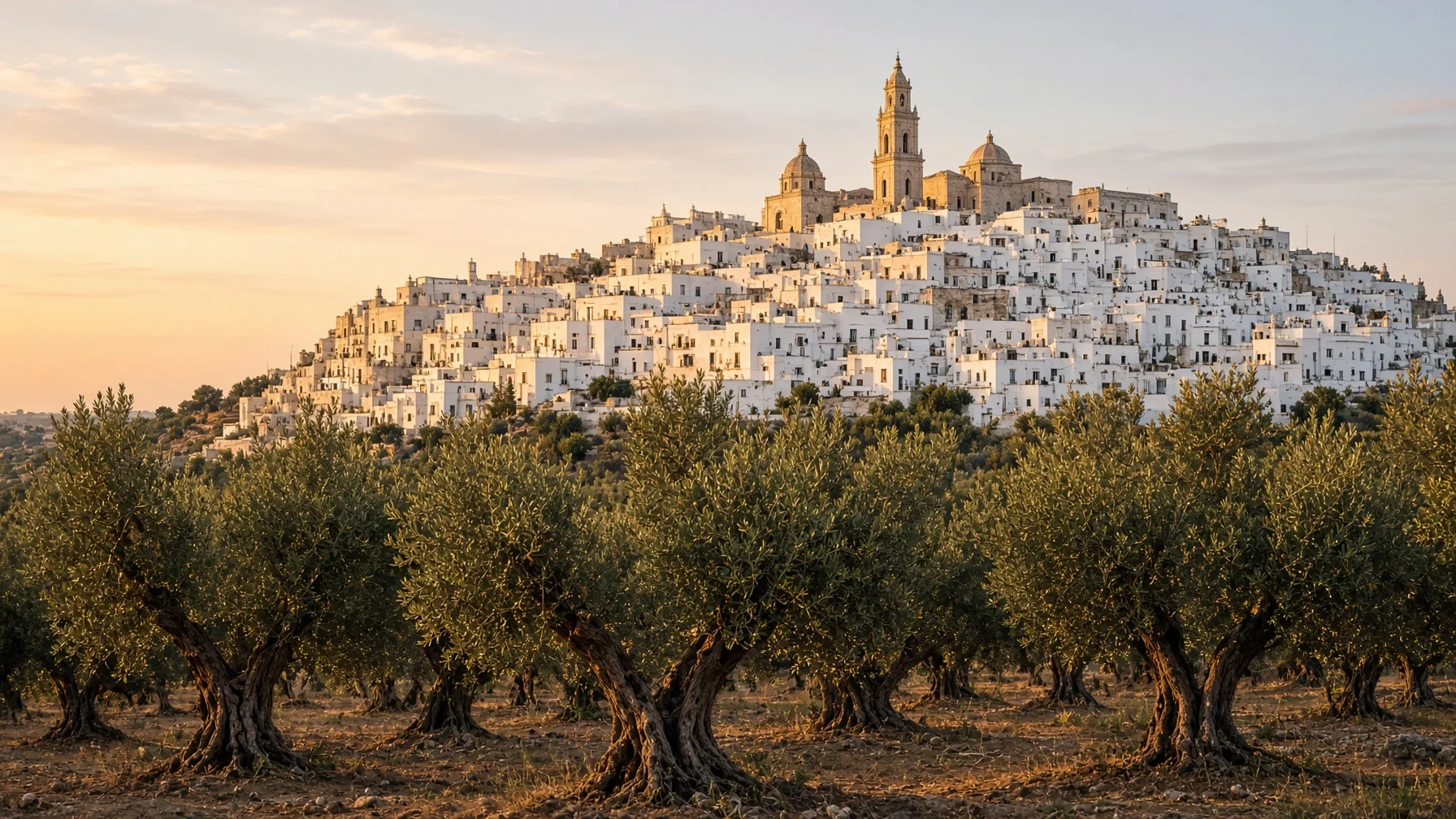
Ostuni sits above the plain on a hill, entirely whitewashed, visible from a long distance across the olive groves. The old town is a compact maze of lime-washed lanes with the cathedral at the summit and a long view down to the Adriatic.
Meanwhile, the smaller towns are the ones that reward time. Locorotondo, Cisternino and Martina Franca hold the same architecture with a fraction of the visitors, and their evening passeggiata is entirely local.
In addition, the valley is the practical center of the region. Nearly everything in northern and central Puglia sits within an hour, which makes it the natural single base for a first visit. For heritage context, see https://whc.unesco.org/en/list/787/
Lecce and the Salento Baroque
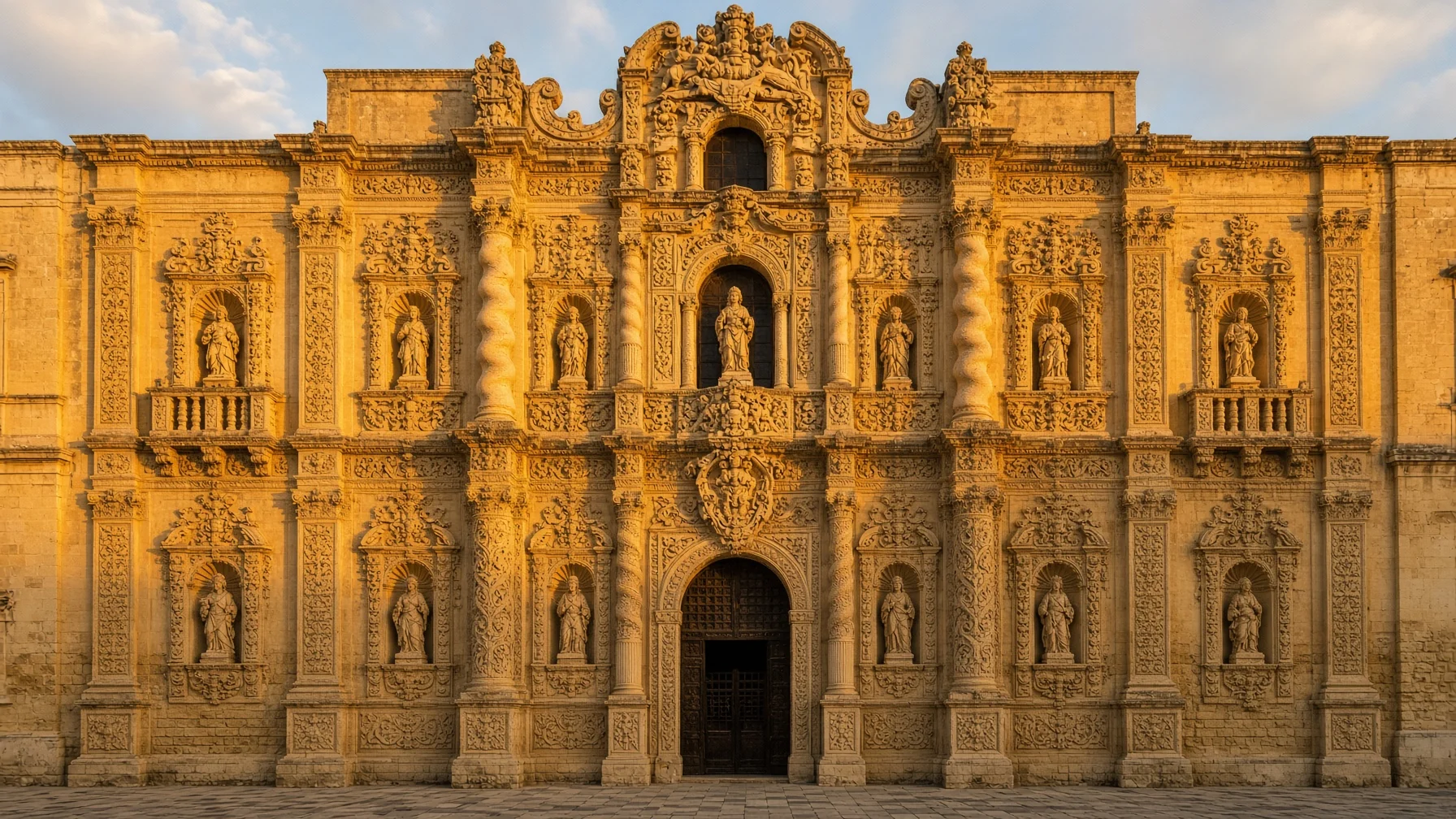
Within Puglia luxury travel, Lecce is the reason to go south. The city was rebuilt in the seventeenth century in a local limestone soft enough to carve like wood, and the result is a baroque unlike anything in Rome or Sicily.
The Basilica di Santa Croce is the extreme statement: a facade covered in figures, animals and foliage carved over a century, held up by caryatids and crowned with a rose window that borders on excess. It is the building that defines the style.
Next, the Piazza del Duomo is the finest enclosed square in southern Italy, entered through a single opening and framed by the cathedral, the bishop’s palace and a campanile that closes the composition. It was designed to be arrived at rather than passed through.
In the center of the city, the Roman amphitheater in Piazza Sant’Oronzo sits sunk several meters below street level, a reminder that the baroque was built directly on a Roman town. Only half of it has been excavated; the rest remains under the surrounding buildings.
As a result, Lecce works as a base rather than a day trip. The city has genuine restaurants, an evening life independent of visitors, and the Salento beaches within forty minutes in either direction.
Two Seas: Adriatic Against Ionian
Puglia has two coastlines with genuinely different characters, and choosing between them determines the shape of the week more than any other decision in Puglia luxury travel.
The Adriatic side, running from the Gargano promontory south through Monopoli and Polignano a Mare to Otranto, is rockier and more dramatic. Towns sit on low cliffs above the water, swimming happens from rock shelves and platforms rather than sand, and the water is deep close to shore. It is also the side with the masserie and the better road connections.
The Ionian side, along the western edge of the Salento peninsula, is the opposite: long sandy beaches, shallow warm water, dunes and pine, and a gentler landscape. It suits families and anyone who wants to walk into the sea rather than climb into it.
In contrast, the two sides also differ in wind. The Adriatic catches the tramontana and can be choppy in spring, while the Ionian is more often calm, which is why the same week can feel entirely different depending on which coast the base sits on.
Finally, the peninsula is narrow enough at its southern end that both seas are reachable in a single day. From a base near Otranto, the drive across to the Ionian sand takes under an hour, which is the strongest argument for spending the second half of a trip in the deep Salento.
The Table: Orecchiette, Primitivo and the Vegetable Tradition
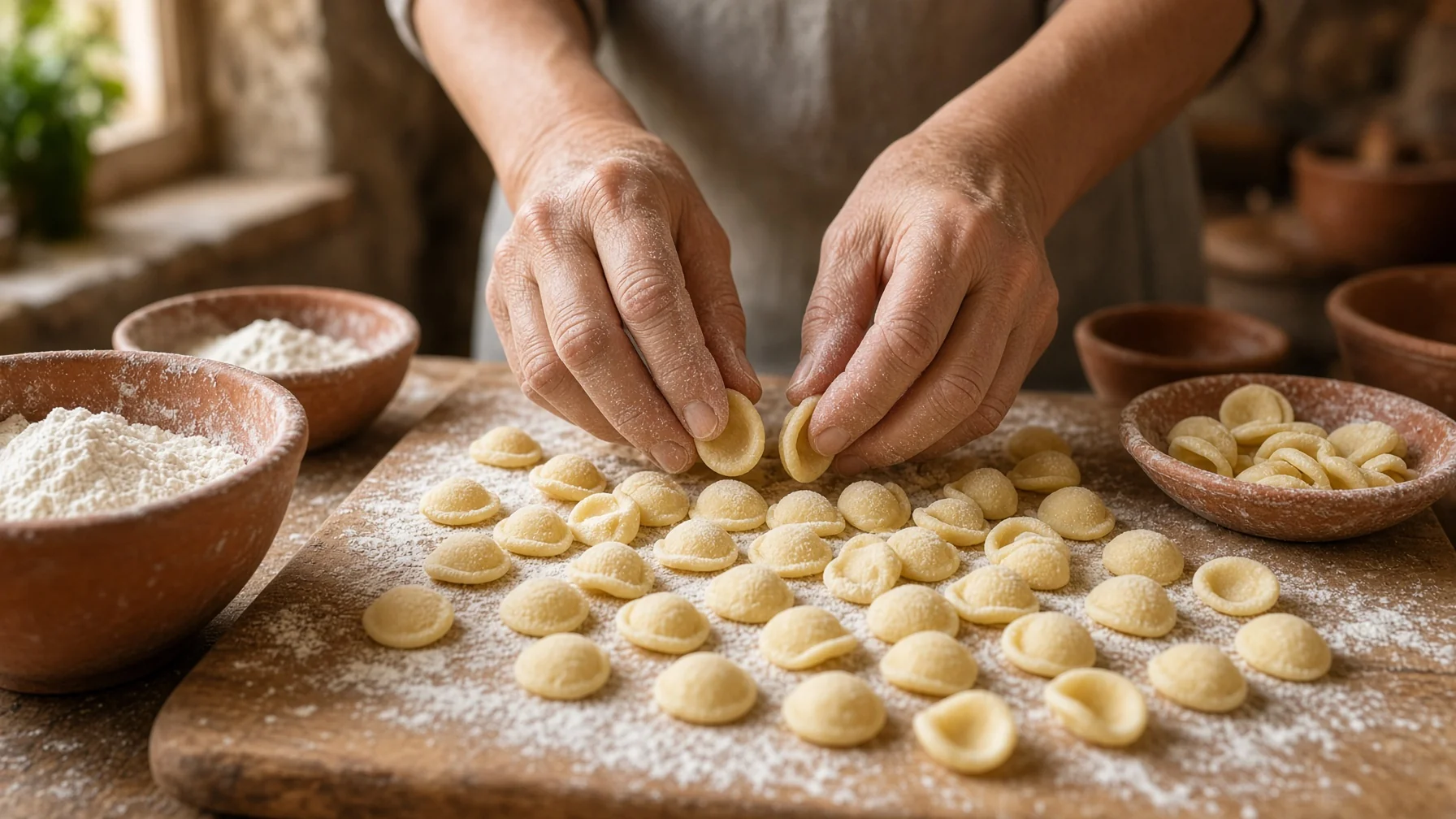
Puglian cooking is the most vegetable-driven in Italy, and it is the region’s quiet argument for going. Centuries of poverty produced a cuisine built on greens, legumes, bread and oil rather than on meat.
Orecchiette is the emblem. The small ear-shaped pasta is still made by hand, dragged across a board with a knife, and served most classically with cime di rapa, anchovy and chili. In the older quarters of Bari, women make it in the street on tables outside their front doors.
The wine follows the same logic. Primitivo from Manduria and Negroamaro from the Salento are dark, warm-climate reds that were sold north in bulk for generations before the region began bottling seriously under its own name.
In addition, the region produces a large share of Italy’s olive oil, and the best estates now run tastings with the same structure as a wine cellar. The difference between a supermarket oil and one pressed within hours of picking is more dramatic than most travelers expect.
Finally, burrata belongs here. It was invented in Andria to use the scraps of mozzarella production, and eaten within a day of being made it bears almost no resemblance to the exported version. A morning at the dairy is one of the more memorable stops in Puglia luxury travel.
White walls, old olives, and two seas an hour apart
Signature Experiences
- Courtyard evenings at a working masseria in the olive groves
- Beach club afternoons on the Adriatic at Masseria Torre Maizza
- Village-scale grounds and family space at Borgo Egnazia
- Early morning in Alberobello before the coaches
- Whitewashed lanes and the hilltop view from Ostuni
- Carved limestone facades and the Piazza del Duomo in Lecce
- Cliff swimming in the coves at Polignano a Mare
- Sunrise over the harbor at Otranto
- Ionian sand and shallow water in the deep Salento
- Making orecchiette by hand with a local cook
- Cellar tasting of Primitivo and Negroamaro
- Olive oil pressing at a working estate in the Valle d’Itria
Let’s Design Your Experience
Puglia still rewards travelers who arrive without a year of planning behind them. At Escape Xperts, we match the masseria to the group and the coast to the season, combining seamless logistics, private access and curated exploration across the region.
Why Travel to Puglia with Escape Xperts
The case for Puglia luxury travel is not that it costs less than the north, but that it is a different country: farm architecture instead of villas, carved limestone instead of Renaissance order, and two seas within an hour of each other. At Escape Xperts, we place travelers inside that landscape rather than alongside it.