Recommended time: Three full days at the temples
Base: Siem Reap
Country: Cambodia
Region: Small Circuit · Grand Circuit · Banteay Srei · Tonlé Sap
Angkor Wat Travel Guide: A City of Temples, Not a Single Monument
This Angkor Wat travel guide starts with a correction: Angkor is not one temple but the remains of successive Khmer capitals, spread over some 400 square kilometers near Siem Reap. Visits follow two main circuits plus outlying sites, and the hour of day changes what each temple shows. Three days is the realistic minimum.
Most travelers plan a single day around the famous silhouette. As a result, they see Angkor Wat at its most crowded, rush through two or three other sites at midday and leave without the temples that make the complex extraordinary.
At EscapeXperts, we plan Angkor by circuit and by light. The sequence below is designed so that each temple is reached at its best hour, with the crowds moving in the opposite direction.
The Small Circuit: Angkor Wat, Angkor Thom and Ta Prohm
The small circuit gathers the best-known sites of the complex. Angkor Wat, the largest religious monument of the Khmer Empire, is its anchor, with galleries of bas-reliefs and thousands of carved apsara figures along its walls.
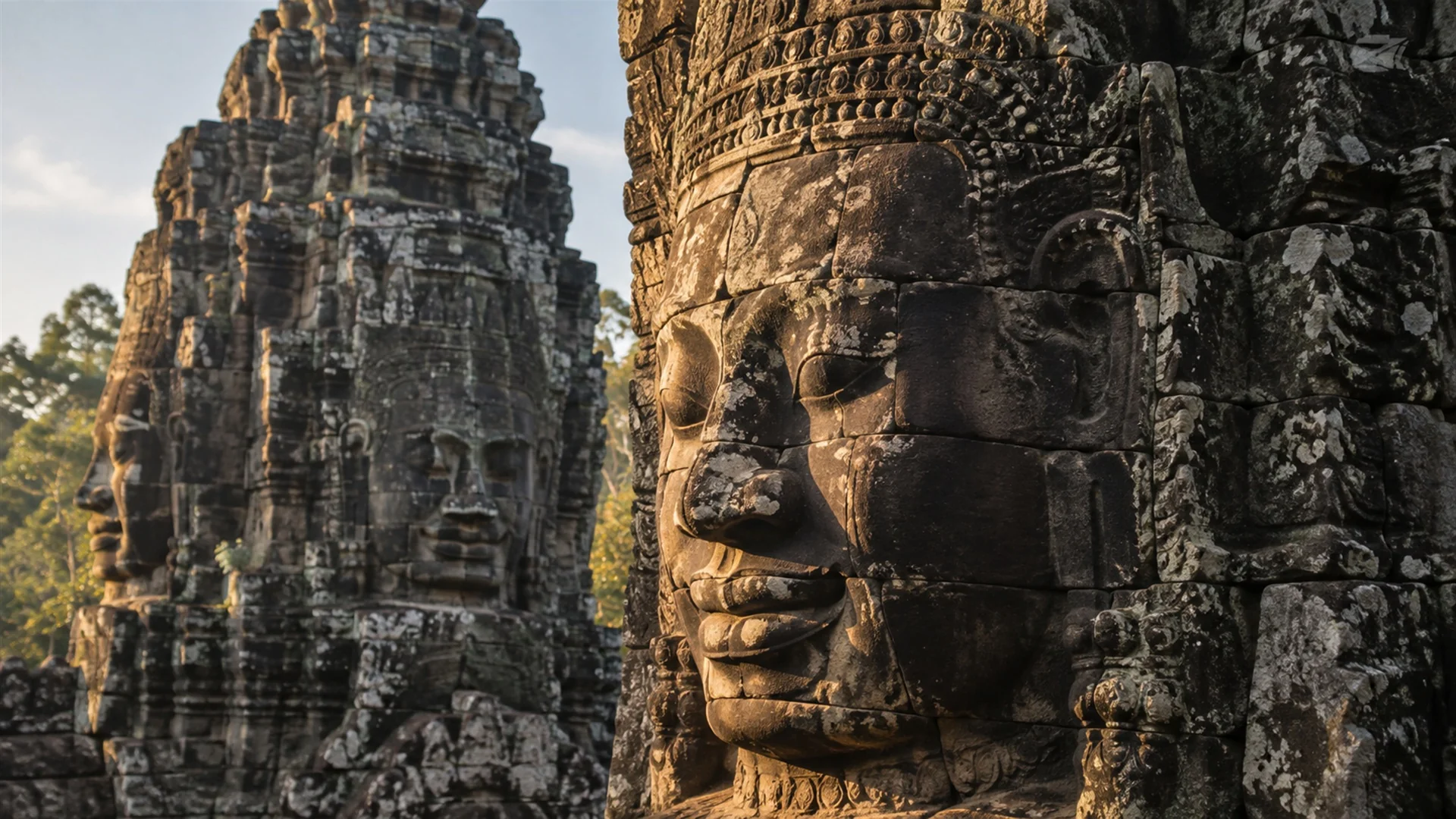
Next, the walled city of Angkor Thom holds the Bayon, whose towers carry serene stone faces turned to every direction. Nearby, the Terrace of the Elephants stretches along the former royal square, its walls lined with carved processions.
The approach is part of the experience. Angkor Thom is entered through monumental gates reached by causeways lined with rows of stone guardian figures, and the South Gate in particular sets the scale of the city within.
Ta Prohm completes the circuit. Here, the forest has been allowed to remain, and the roots of giant trees grip the walls and doorways. It is one of the most photographed places at Angkor, and it rewards an early arrival more than any other temple.
Because the small circuit concentrates the famous names, it also concentrates the visitors. For this reason, the order matters as much as the selection in any serious Angkor Wat travel guide.
Most groups follow the same pattern: sunrise at Angkor Wat, then the Bayon and Ta Prohm through the morning. Reversing that sequence, or shifting it by a few hours, is the simplest way to find space. Here, a private guide and driver make the difference, adjusting the route to what the crowds are doing on the day.
The Grand Circuit and Preah Khan
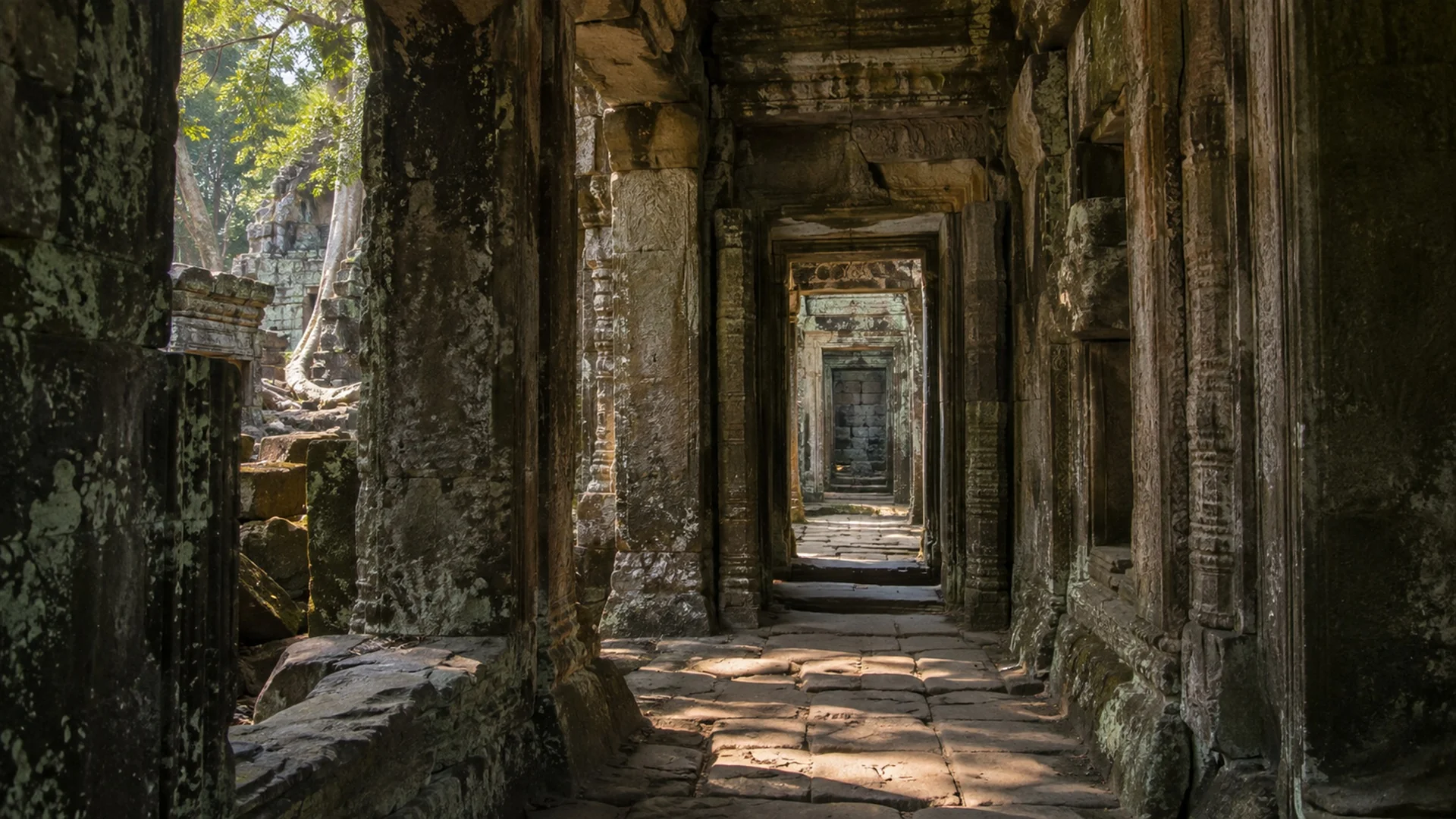
The grand circuit extends the loop to the north and east. Its highlight is Preah Khan, a vast temple of long corridors, carved doorways and partial ruins, where the forest softens the stone without overwhelming it.
Preah Khan receives far fewer visitors than Ta Prohm, yet it offers a similar atmosphere of stone and forest. In addition, its scale gives a clearer sense of how these temples once functioned as whole communities rather than as isolated shrines.
Along the same route, smaller temples such as Neak Pean, set within a series of pools, and Pre Rup, with its warm brick towers, add variety. Pre Rup is also a favored spot at the end of the afternoon, when its stone takes on a deep amber tone.
Therefore, the grand circuit is where Angkor begins to feel like a landscape rather than a list of sights. It deserves a full day of its own.
Further Out: Banteay Srei
Around an hour’s drive north of the main group, Banteay Srei is one of the smallest temples of the region and one of the most refined. Built in pink sandstone, it is covered in carvings of remarkable depth and precision.
Its scale is intimate. Rather than towering galleries, it offers doorways, lintels and pediments that invite close attention. Consequently, many consider it the finest example of Khmer decorative art.
Banteay Srei is best visited in the early morning, when the pink stone glows and the light reveals the relief. Meanwhile, the countryside on the way, with rice fields and village life, provides a welcome contrast to the main temple zone.
Combined with Preah Khan or with the waterfalls and carved riverbeds further north, it anchors the day that one-day visitors never see. That day is the one this Angkor Wat travel guide would protect above all others.
Reading the Light: Sunrise and Late Afternoon
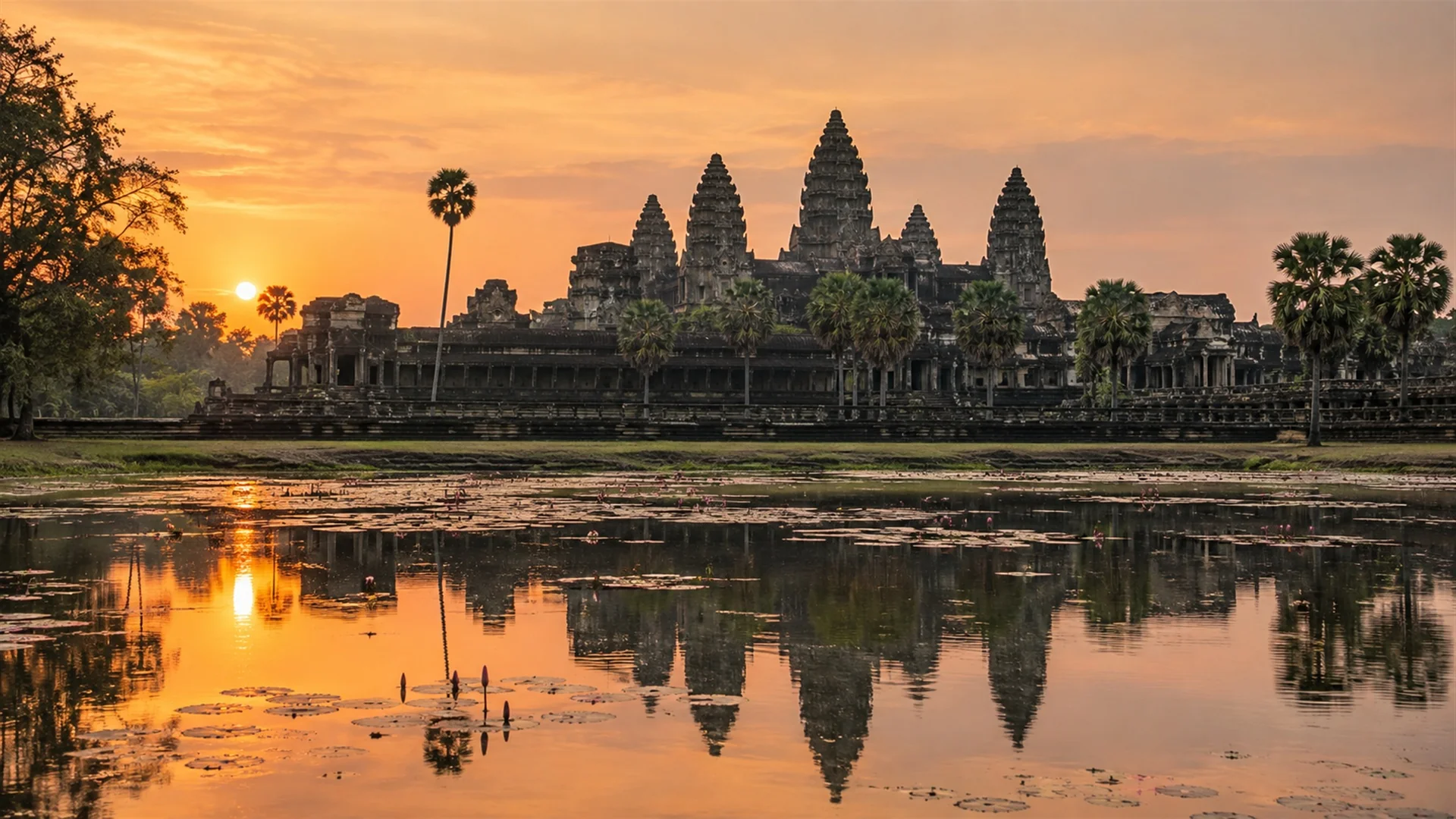
Sunrise at Angkor Wat is famous, and it is also the busiest moment of the day at the complex. Large crowds gather in the dark around the reflecting pools, and the experience is shared rather than solitary.
It can still be worthwhile, provided the expectation is honest. Alternatively, travelers may watch the dawn from a quieter vantage point on the grounds, or skip sunrise altogether and enter the temple once the crowds move on to breakfast.
Angkor Wat faces west, so its main facade is best lit in the afternoon. In contrast, the Bayon reveals its faces most clearly in low early or late light, and Ta Prohm is most atmospheric in the soft light of the first hours.
Sunset follows the same logic. The hill temple of Phnom Bakheng is the traditional viewpoint, but access to its summit is limited and it fills early. Pre Rup, on the grand circuit, offers a calmer alternative with an open view across the forest, and it suits the close of any day planned with this Angkor Wat travel guide.
As a result, a refined plan often visits Ta Prohm at opening, rests at midday and returns to Angkor Wat in the late afternoon. This rhythm sits at the heart of our Angkor Wat travel guide.
Angkor Wat Travel Guide: How Many Days, and Siem Reap as a Base
One day at Angkor allows the small circuit and little else. Two days add the grand circuit. Three days allow Banteay Srei, a return to the favorite temples and the midday rest that makes the heat manageable.
Because of this, three full days is the recommendation of this Angkor Wat travel guide, and four allows the pace that the complex truly deserves. Multi-day passes are designed precisely for this kind of visit.
Siem Reap makes an easy base. Amansara, a small and serene retreat in the town, offers a quiet return between temple sessions, while restaurants and evening performances of apsara dance extend the experience after dark.
The town also sets the daily rhythm. Temples are a short drive away, so a return for lunch and a rest during the hottest hours is easy, and the afternoon session starts fresh.
Finally, the great lake of Tonlé Sap, a short drive away, adds a different perspective, with floating villages and flooded forest. For heritage context, see https://whc.unesco.org/en/list/668/
Stone faces, forest roots, and light across the temples
Signature Experiences
- Late afternoon light on the west facade of Angkor Wat
- Stone faces of the Bayon in low morning light
- An early arrival at Ta Prohm before the crowds
- The quiet corridors of Preah Khan
- Pink sandstone carvings at Banteay Srei
- A walk along the Terrace of the Elephants
- Sunset over the brick towers of Pre Rup
- A boat journey to the floating villages of Tonlé Sap
- An evening of apsara dance in Siem Reap
Ready for Something Extraordinary?
Angkor rewards travelers who give it time and plan it with care. At EscapeXperts, we design each day around circuit and light, combining seamless logistics, private experiences and curated exploration so that every temple is reached at its best hour.
Why Travel to Cambodia with EscapeXperts
Angkor is a landscape of temples, and seeing it well depends on the order, the hour and the number of days. At EscapeXperts, we sequence each circuit against the crowds, select the right base in Siem Reap and leave room for the temples beyond the famous silhouette. The result is an Angkor Wat travel guide made real.