Cities: Delhi · Agra · Jaipur
Road distances: roughly 230 to 280 km between each pair of cities
Country: India
Region: Delhi · Uttar Pradesh · Rajasthan
Golden Triangle India: The Route Behind the Reputation
The Golden Triangle India route links Delhi, Agra and Jaipur, three cities set roughly four to five hours apart by road. It gathers the Taj Mahal, the Mughal monuments of the capital and the forts of Rajasthan into one journey. The distances, not the sights, shape the plan.
The name has become shorthand for a coach tour, and many experienced travelers dismiss it for that reason. However, the route itself is not the problem. The problem is how it is usually sold: compressed, rushed and stripped of the hotels that make it exceptional.
At EscapeXperts, we treat the Golden Triangle India journey as a first introduction to the country, planned around real road times and some of the finest palace hotels in the world.
The Distances That Shape the Golden Triangle India Journey
On a map, the three cities look close. On the road, each leg is a significant part of the day. Delhi to Agra covers roughly 230 km along the Yamuna Expressway, usually around three and a half to four hours by car once city traffic is included.
Next, Agra to Jaipur runs for roughly 240 km, generally four to five hours. The return from Jaipur to Delhi, at around 270 km, often takes five hours or more, depending on the approach to the capital.
Rail changes the equation for the first leg. Fast trains connect Delhi and Agra in under two hours, and a morning departure can deliver travelers to the Taj Mahal area well before lunch. Therefore, many refined journeys combine rail and private car, rather than relying on the road alone.
Because of these distances, three cities in three days is a transit schedule, not a journey. Two nights in each city, or at least in Agra and Jaipur, turns the route into something considered.
The order matters as well. Most journeys begin in Delhi, continue to Agra and end in Jaipur, which has its own airport, so the long road back to the capital can be replaced by a short flight. As a result, a well-sequenced Golden Triangle India route spends its hours on monuments rather than on highways.
Delhi Beyond the Obvious
Delhi is often treated as an arrival city and little more. Yet it holds some of the most significant monuments in the country, and the quieter ones reward an unhurried morning.
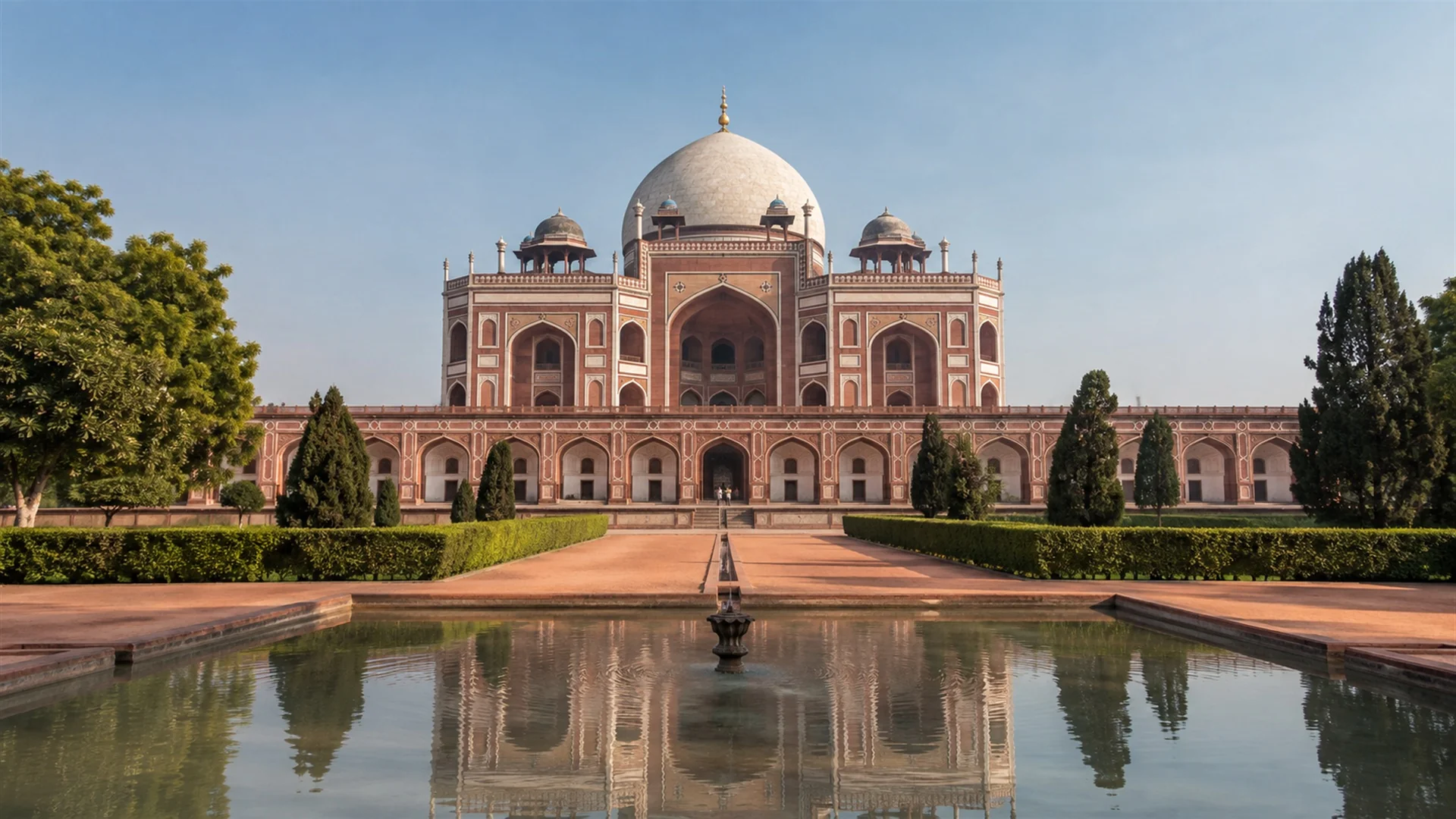
Humayun’s Tomb, set in formal gardens in the south of the city, is a Mughal mausoleum of the sixteenth century and a clear forerunner of the Taj Mahal. Visited early, before the heat and the groups, its symmetry is at its most striking.
In addition, the Qutub Minar complex, with its soaring stone minaret of the early Delhi Sultanate, reveals an earlier chapter of the city’s history. Both are UNESCO World Heritage Sites, and both receive a fraction of the attention given to the Taj.
Meanwhile, the lanes of Old Delhi offer a vivid contrast, best explored with a private guide in the morning. For the night, The Leela Palace New Delhi, in the diplomatic enclave, provides a calm and palatial base after the intensity of the streets.
The Taj Mahal at First Light
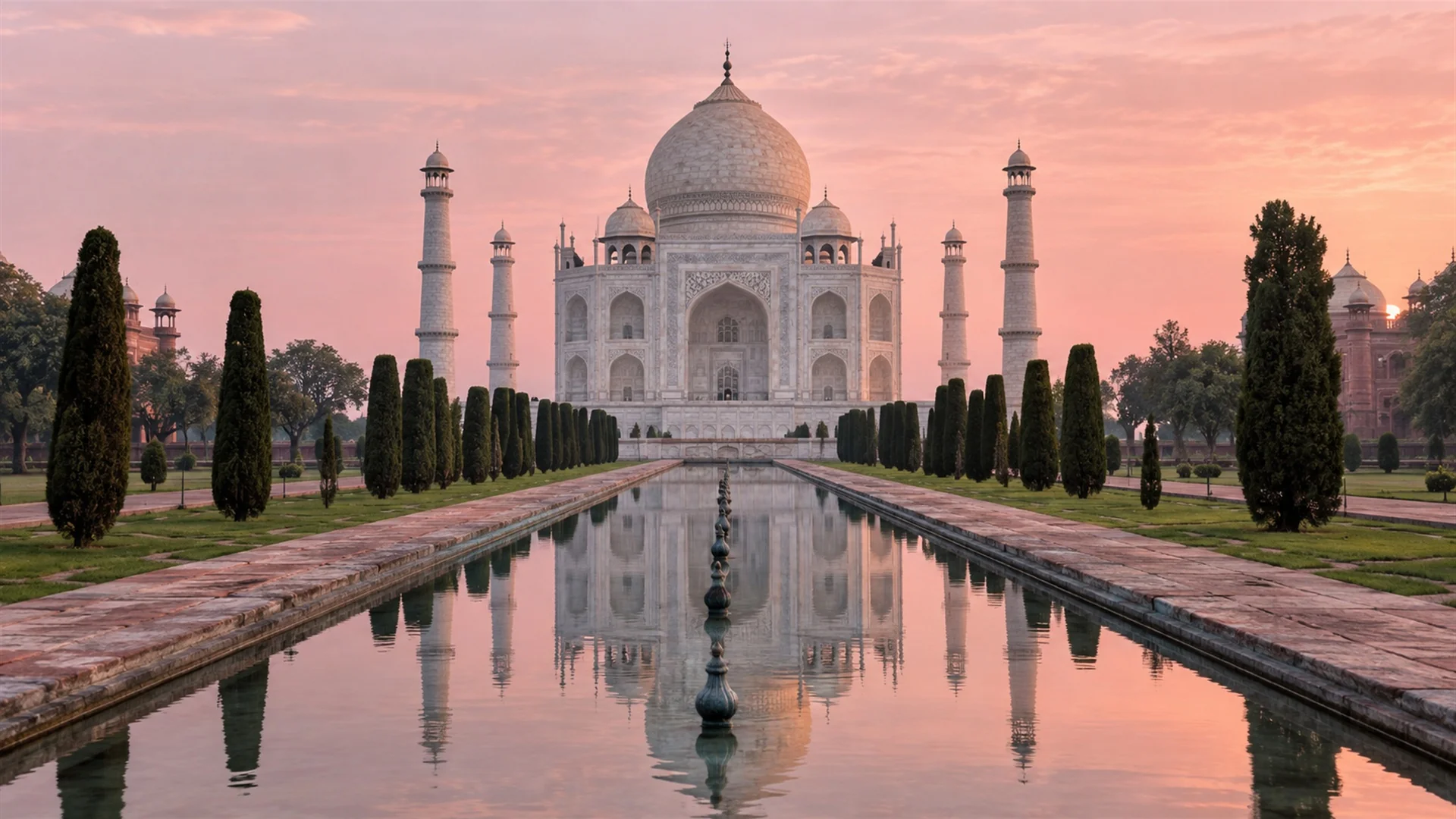
The Taj Mahal opens its gates thirty minutes before sunrise, and those first minutes are the finest of the day. The marble shifts from grey to pale pink to white, and the gardens are at their quietest before the day visitors arrive.
The monument closes every Friday. This single detail shapes the route more than any other, because a Friday in Agra without planning means a lost visit. As a result, the order of the three cities is often set around it, and in any Golden Triangle India plan the Agra night is the one fixed first.
Staying in Agra the night before makes the sunrise visit effortless. The Oberoi Amarvilas sits a short distance from the monument, with views of the Taj from its rooms, so the first sight of the day can come from the balcony before the walk to the gate.
Later, the Mehtab Bagh gardens across the Yamuna River offer a quieter perspective at the end of the afternoon. Agra Fort, a UNESCO site in its own right, completes the visit and is often best seen in the middle of the day.
Jaipur: Amber Fort and the Pink City
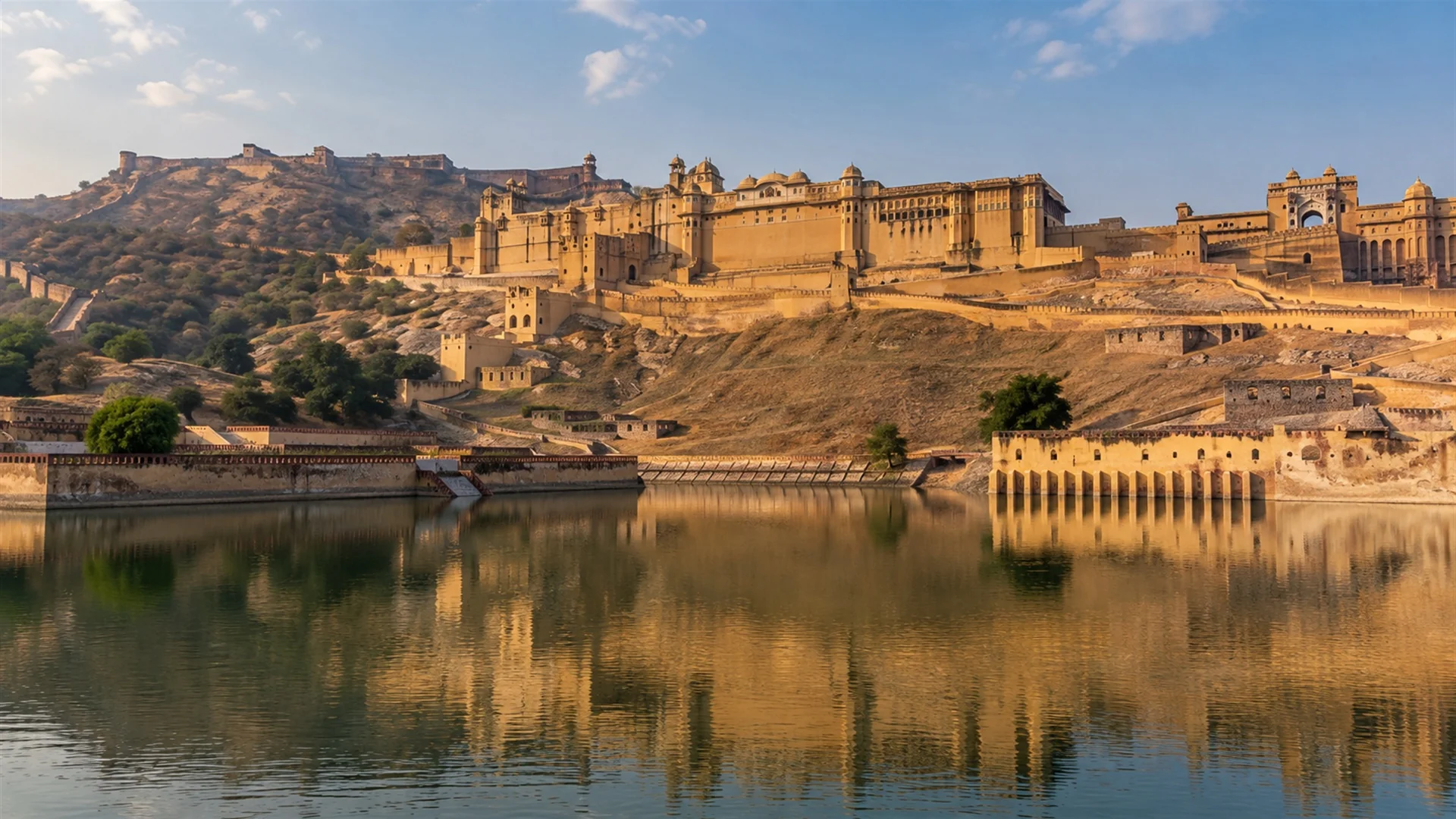
Jaipur brings the Golden Triangle into Rajasthan, and the change is immediate. The old city is painted in its distinctive shade of pink, and the Hawa Mahal, with its honeycomb facade of latticed windows, faces the main street.
Above the city, Amber Fort stretches along a ridge overlooking Maota Lake. Its courtyards, mirrored halls and ramparts are part of the Hill Forts of Rajasthan UNESCO site, and an early arrival avoids both the heat and the queues at the gate.
Here, the city palace, the astronomical instruments of Jantar Mantar and the craft workshops of the old city fill the remaining time. Because of this, Jaipur rewards two full days rather than a single afternoon.
Jaipur is also the natural entry point to the rest of Rajasthan. Travelers who continue west to the desert cities and lake palaces will find that region deserves its own chapter.
Sleeping in a Palace
The palace hotel is a category of its own in India. These are former royal residences, or properties built in that tradition, where the architecture, gardens and service carry the weight of history rather than simply its style.
Around Jaipur, Samode Palace, in a village outside the city, offers painted halls and courtyards in a setting that still feels removed from the modern world. Oberoi Rajvilas, set in gardens on the edge of the city, recreates a royal estate with villas and private courtyards.
In the city itself, Rambagh Palace, once a residence of the Maharaja of Jaipur, keeps its lawns, courtyards and ceremonial scale, and remains one of the defining addresses of the region.
In contrast, Oberoi Rajvilas and the palatial hotels of Delhi and Agra, such as The Leela Palace New Delhi and The Oberoi Amarvilas, are modern buildings designed in the grand manner. The distinction matters: one is heritage lived in, the other heritage interpreted.
A heritage hotel, by comparison, is usually a smaller historic property, such as a merchant’s mansion or a nobleman’s residence, converted with fewer rooms and a more intimate character. It suits travelers who prefer atmosphere to grandeur, and it offers a different way of reading the same history.
Either way, the hotel becomes part of the Golden Triangle India experience rather than a place to sleep between monuments. For heritage context, see https://whc.unesco.org/en/list/252/
Marble at dawn, sandstone forts, and palaces made for staying
Signature Experiences
- Sunrise at the gates of the Taj Mahal
- Taj views from a balcony at The Oberoi Amarvilas
- An early morning at Humayun’s Tomb and its gardens
- The minaret and ruins of the Qutub Minar complex
- A guided walk through the lanes of Old Delhi
- Late afternoon views of the Taj from Mehtab Bagh
- The ramparts and mirrored halls of Amber Fort
- The latticed facade of the Hawa Mahal in the Pink City
- Painted halls and courtyards at Samode Palace
- A fast morning train from Delhi to Agra
Ready to Begin the Journey?
The Golden Triangle rewards travelers who give it time and the right rooms. At EscapeXperts, we plan the route around its real distances, combining seamless logistics, private experiences and curated exploration from the Mughal capital to the gates of Rajasthan.
Why Travel to India with EscapeXperts
India’s most famous route is also its most misunderstood, and the difference lies in the planning. At EscapeXperts, we set the order of the cities around the Friday closure, the road times and the light, and we choose palace hotels that belong to the journey. The result is a Golden Triangle India experience worthy of its name.