Ideal stay: 3 to 4 nights
Best months: November to March, in the cool dry season
Country: Laos
Region: Old Town peninsula · Mekong · Nam Khan · Northern hills
Luang Prabang Luxury Travel: A Royal Town at the Meeting of Two Rivers
Luang Prabang luxury travel is, above all, a matter of pace. The former royal capital of Laos sits on a narrow peninsula where the Nam Khan meets the Mekong, and its temples, teak houses and colonial villas have been preserved as a single townscape.
UNESCO inscribed the town on the World Heritage List in 1995, recognizing the blend of Lao monastic architecture and later European colonial buildings. As a result, Luang Prabang is often described as the best-preserved town in Southeast Asia, and it rewards visitors who stay long enough to notice its rhythm.
At EscapeXperts, we treat the town as a place to slow down rather than a stop to tick off. This guide covers the morning alms round, the temples, the river and the waterfalls in the hills, with the practical detail that makes each one unhurried.
The Tak Bat at Dawn, and How to Take Part With Respect
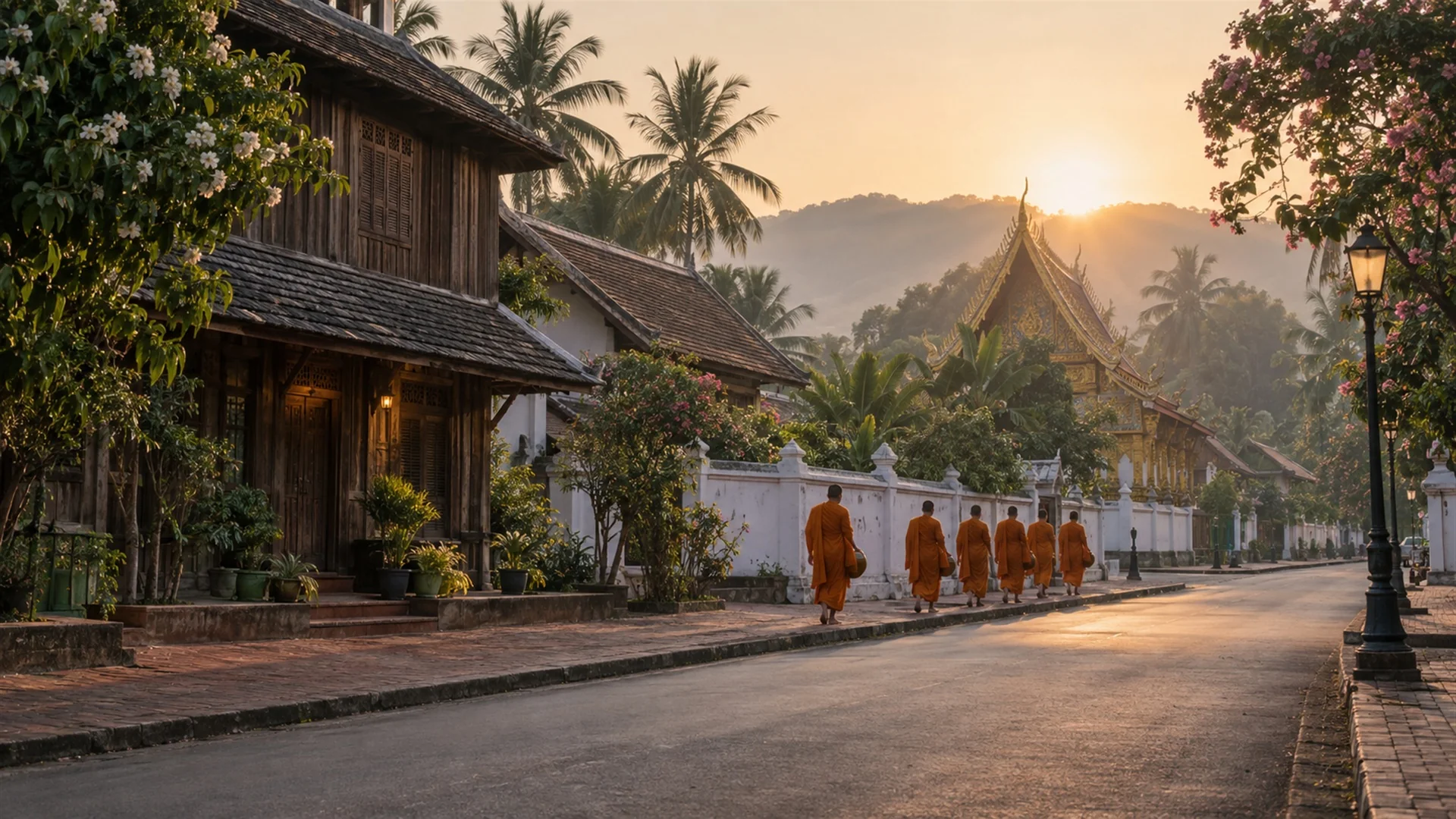
Each morning, around first light, lines of monks leave the monasteries and walk the streets of the old town in silence. Residents kneel along the pavements and place a small portion of sticky rice in each bowl. This is the tak bat, a daily religious practice, not a performance staged for visitors.
Because the ceremony has become one of the most photographed moments in Laos, its dignity depends on how visitors behave. Shoulders and knees should be covered. Observers are asked to stand back several meters on the opposite side of the street, remain silent, and never step into the path of the procession.
In addition, flash photography, close-up lenses and any physical contact with monks are inappropriate. Women in particular should avoid touching a monk or his robes. A photograph, if taken at all, belongs at a discreet distance and without interrupting the line.
Visitors who wish to give alms should do so only if the gesture carries meaning for them. The accepted form is to kneel or sit lower than the monks, with shoes removed, and to offer freshly prepared sticky rice. Rice sold by street vendors along the route is best avoided; your hotel can prepare the offering the evening before.
Handled this way, the tak bat becomes the quiet opening of Luang Prabang luxury travel rather than a crowd scene. Quieter side streets away from the main road offer the most respectful vantage points.
Temples, the Royal Palace and the View From Mount Phousi
The old town is compact enough to explore on foot, ideally in the early morning or late afternoon. Dozens of monasteries still function within and around it, and each rewards an unhurried visit.
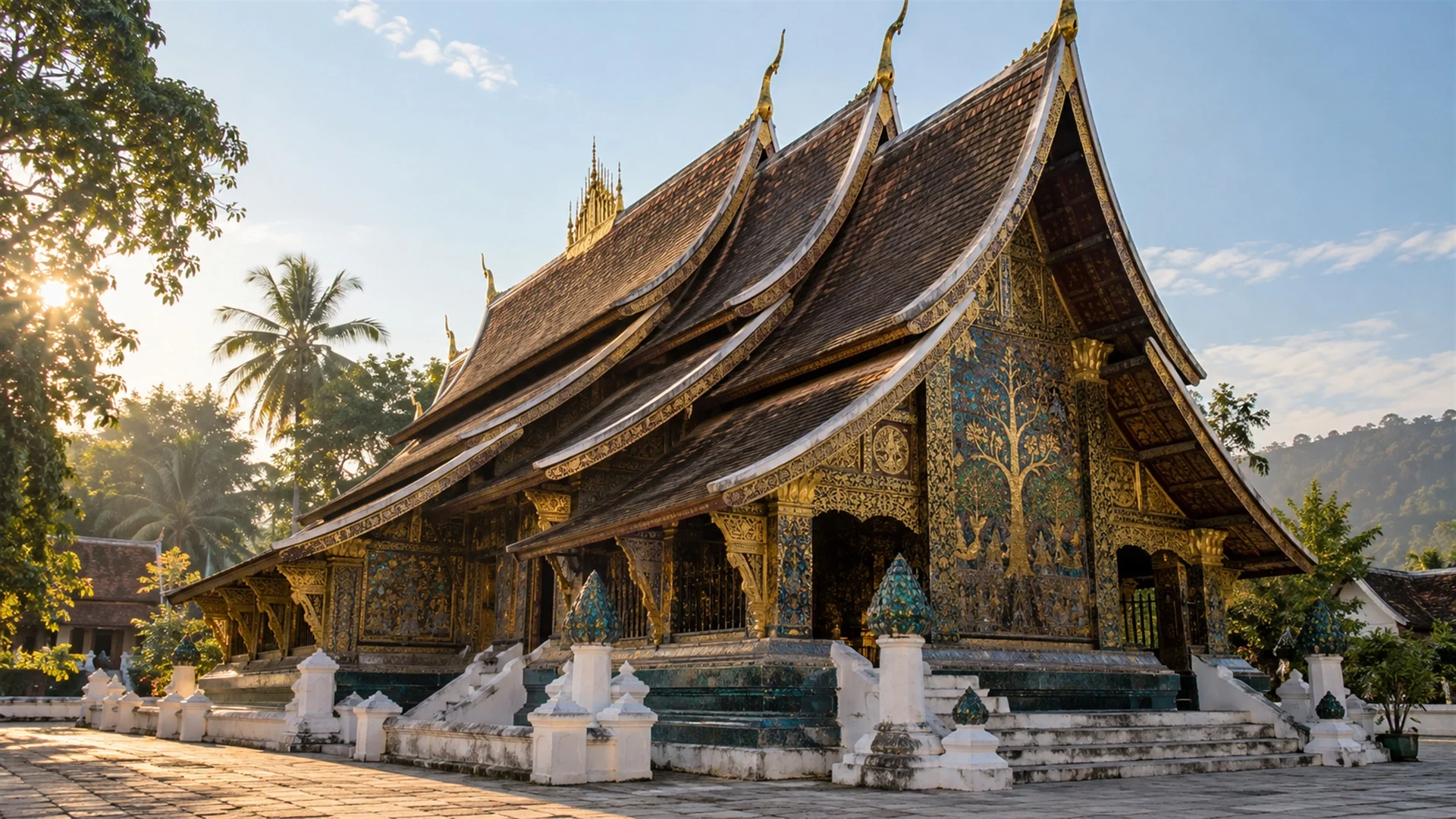
Wat Xieng Thoung, near the tip of the peninsula, is the town’s most celebrated temple. Its sweeping, low roofs and glass mosaic panels express the classic Luang Prabang style, and the sixteenth-century complex remains an active place of worship.
Meanwhile, the Royal Palace Museum on the main street recalls the town’s royal past. Built in the early twentieth century for the Lao monarchy, it preserves throne rooms, ceremonial objects and the gifts of foreign delegations, while the adjacent shrine houses the Phra Bang image that gives the town its name.
Across the street, a stairway of several hundred steps climbs Mount Phousi, the hill at the center of the peninsula. The summit stupa overlooks both rivers and the surrounding forested hills. The climb is steady rather than steep, and early morning is calmer and cooler than the sunset hour.
This layered heritage is what gives Luang Prabang luxury travel its depth, and a private guide can open doors to monasteries and craft workshops that are easy to pass by.
Up the Mekong to the Pak Ou Caves and the Craft Villages
The river journey to the Pak Ou Caves is one of the classic excursions from town. The caves sit in a limestone cliff roughly 25 kilometers upstream, at the confluence of the Mekong and the Nam Ou river.
Travel upstream by private long-tail boat typically takes around one and a half to two hours, with the return downstream closer to one hour. As a result, the excursion fills a relaxed morning, with time to stop along the way.
The lower cave, Tham Ting, is reached by a short stairway from the landing and holds thousands of Buddha images left by pilgrims over centuries. The upper cave, Tham Theung, requires a longer climb and a flashlight, so it suits travelers comfortable with steps.
Next, the return journey often includes riverside villages known for their crafts. One village along the route is known for its rice spirit and hand-woven textiles, while Ban Phanom, just east of town, has long been associated with silk and cotton weaving. Here, looms still operate beneath stilted houses.
These stops connect the river to the people who live along it, an essential thread in any considered program of Luang Prabang luxury travel.
Kuang Si Falls and the Quiet Hours of Luang Prabang Luxury Travel
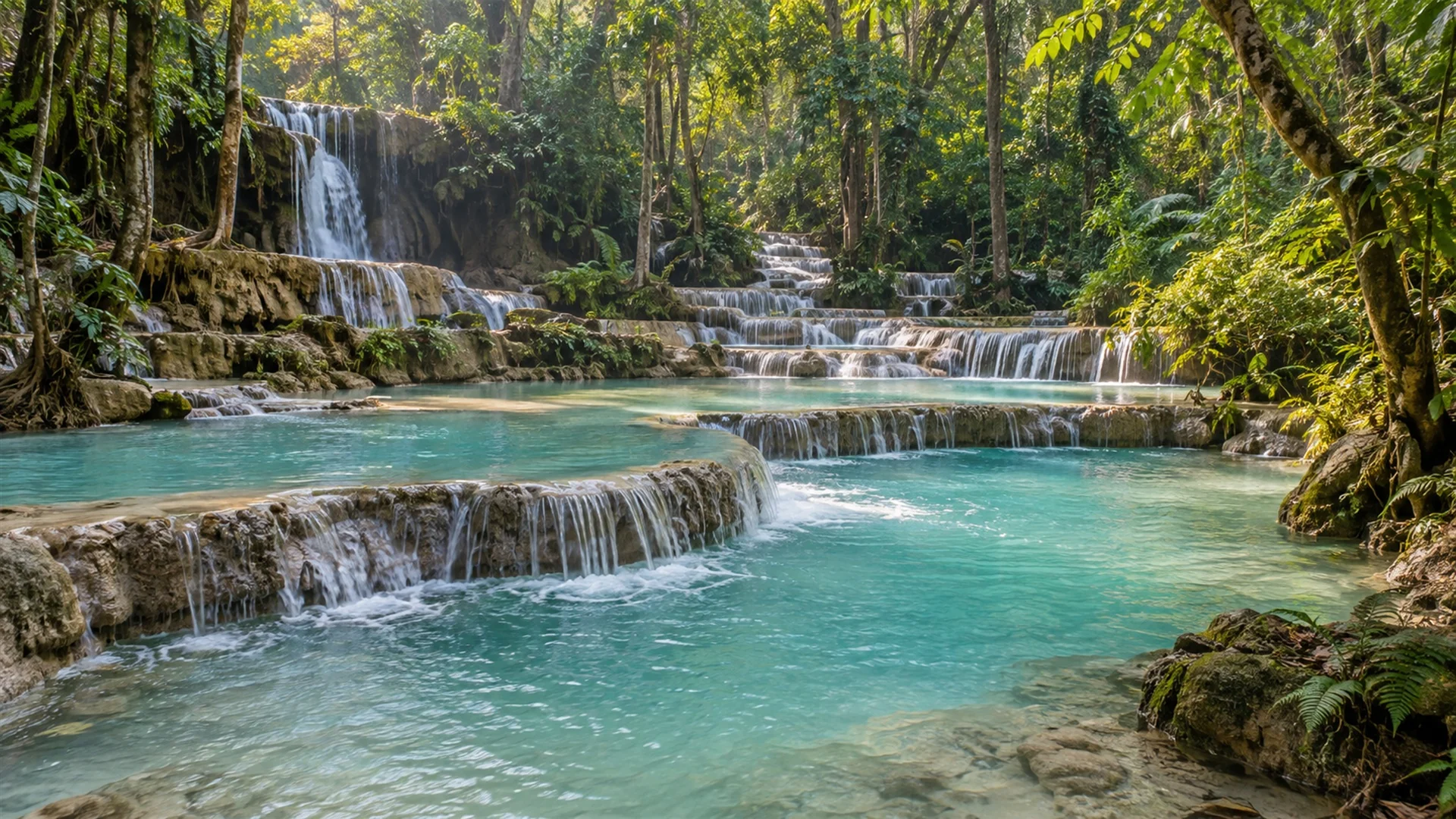
Kuang Si Falls lies about 29 kilometers south of town, a drive of roughly 45 minutes to an hour through rice fields and small villages. The waterfall descends in a series of turquoise limestone pools framed by forest.
Timing makes the difference. By late morning, the lower pools become busy, so a private driver and an early departure offer a far calmer experience. Therefore, many travelers leave town shortly after breakfast and return for a late lunch.
Well-kept paths lead from the entrance to the main cascade, passing a bear rescue center near the gate. A steeper trail climbs beside the falls to the upper pools, while the lower terraces remain accessible for most visitors. Swimming is permitted in designated pools, and modest swimwear is expected.
The water is clearest in the dry season, from roughly November to April. During the rains, the falls grow more powerful but the pools turn cloudy, and the paths become slippery. Planned around the early hours, the excursion becomes one of the calmest days of Luang Prabang luxury travel.
Where to Stay: Amantaka and Rosewood Luang Prabang
Two properties anchor the town’s most refined accommodation. Amantaka occupies restored French colonial buildings within walking distance of the old town, with spacious suites and a calm garden setting.
In contrast, Rosewood Luang Prabang sits in a forested valley a short drive outside town, with tented villas and rooms arranged along a stream. It suits travelers who prefer to return to nature after a day in the temples.
Both can arrange private guides, boat charters and tak bat offerings prepared in the proper manner. Because of this, the choice rests on setting: heritage streets on the doorstep, or a quiet retreat in the hills.
For official heritage information, see https://whc.unesco.org/en/list/479/
Saffron dawns, slow rivers, and a town that keeps its own time
Signature Experiences
- Observing the tak bat from a respectful distance at dawn
- Offering freshly prepared sticky rice with guidance from your hotel
- Private visit to Wat Xieng Thoung at the tip of the peninsula
- Guided tour of the Royal Palace Museum
- Early morning climb of Mount Phousi above both rivers
- Private long-tail boat up the Mekong to the Pak Ou Caves
- Weaving demonstrations in Ban Phanom
- Quiet morning swim at Kuang Si Falls
- Sunset along the banks of the Nam Khan
- Heritage stay at Amantaka or a valley retreat at Rosewood Luang Prabang
Ready to Begin the Journey?
Luang Prabang rewards travelers who give it time and treat its traditions with care. At EscapeXperts, we arrange each day around the town’s natural rhythm, combining seamless logistics, private guides and curated experiences that keep every moment unhurried.
Why Travel to Luang Prabang with EscapeXperts
Luang Prabang is best understood slowly, from the silence of the morning procession to the evening light on the Mekong. At EscapeXperts, we plan the quiet hours at the waterfalls, the private boats to Pak Ou and the stays that suit your pace, with clear guidance on local customs. The result is Luang Prabang luxury travel that is respectful, restful and rich in meaning.