Warmest sea: September, not August
Quietest good months: May · late September · October
Windiest period: July and August, across the Aegean
Regions: Aegean islands · Ionian islands · Athens · Peloponnese · Meteora
Best Time to Visit Greece: Reading the Sea, the Wind and the Calendar
The best time to visit Greece is decided by three variables that no climate table records: the temperature of the water, the behavior of the summer wind, and the Orthodox calendar. Air temperature, the figure most guides publish, is the least useful of the four.
At Escape Xperts, we plan Greek travel around the sea rather than the thermometer. The country is not a summer destination with a high season; it is four distinct seasons on the same water, and each one favors a different kind of trip.
April to June: The Opening, and the Sea That Has Not Caught Up
The season opens gradually. April is green, wildflowers cover the hillsides, and the archaeological sites are at their most comfortable, but many island properties are still closed and ferry schedules run on winter frequencies.
For travelers who value space over swimming, May is the best time to visit Greece and the first month that works completely. Daytime temperatures settle in the mid-twenties, the light is clear, tavernas open their terraces, and the crowds have not arrived. The one caveat is the water, which is still around nineteen or twenty degrees and reads as cold to most swimmers.
June corrects that. The Aegean Sea climbs through the low twenties over the course of the month, the days lengthen toward the solstice, and the wind has not yet established itself. For travelers who want warm swimming with genuine space, the second half of June is the strongest window of the first half of the year.
Therefore, spring is the period for movement. Walking, sites, boat days in calm water and long lunches outdoors all work better now than at any point in high summer, and the islands feel like places where people live.
Because of this, May and June also demand earlier planning than their reputation suggests. The best properties open in April and fill their June allocations first, which makes the shoulder season the part of the year with the longest booking lead.
July and August: The Meltemi Season
The Meltemi is the variable that separates people who know the Aegean from people who have read about it. It is a dry northerly wind that establishes itself in July, peaks in August, and can blow for three or four consecutive days at a time.
Its practical effects are considerable. Ferry and hydrofoil services are cancelled or rerouted at short notice, small-boat charters lose days, north-facing beaches become unswimmable, and dinner on an exposed terrace turns into an exercise in holding down the tablecloth.
It is not, however, a reason to avoid the season. The wind cools the air, keeps humidity low and produces the extraordinary visibility that defines Aegean summer light. Sailors actively plan around it, and south-facing coasts stay sheltered throughout.
Meanwhile, the Ionian Sea on the western side of the country is barely affected. Its summer is hotter, greener and considerably calmer, which is the strongest argument for shifting a July or August trip from one side of Greece to the other.
In addition, August carries the domestic peak. Greek families take their own holidays through the month, the fifteenth is a major national holiday, and both the ferries and the tavernas run at capacity. Any itinerary that must sit in August should be built with one base and a boat rather than a route.
September and October: When the Sea Is at Its Warmest
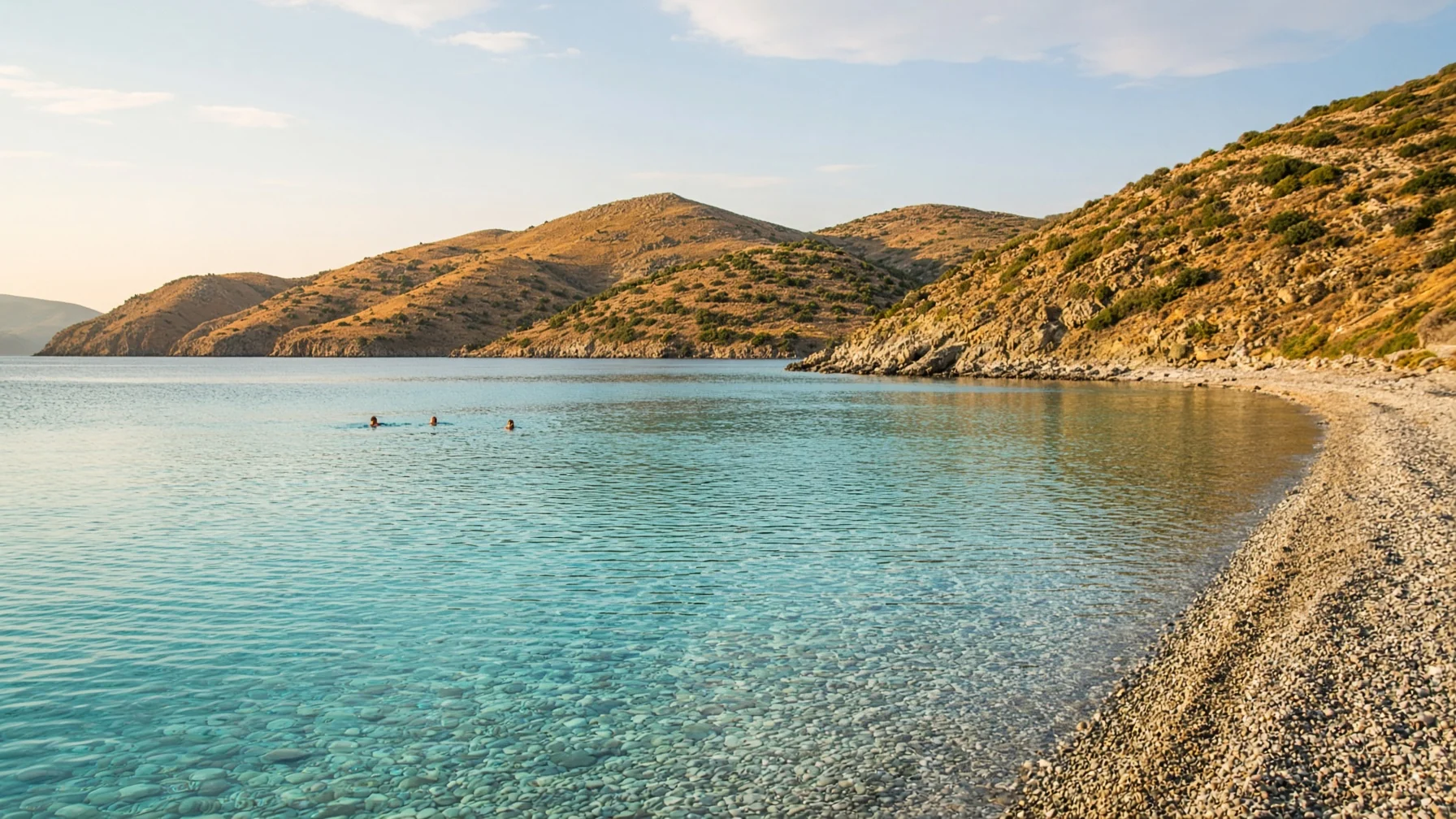
Asked for the best time to visit Greece, most experienced travelers name this pair of months. The sea holds the heat it accumulated all summer and reaches its annual maximum in September, typically a degree or two above the August figure, and it stays swimmable through October.
At the same time, the Meltemi collapses. September winds drop sharply, crossings become reliable, and small boats can reach the coves that were inaccessible six weeks earlier. Outdoor dinners stop being a wind calculation.
The crowd thins just as abruptly. Northern European schools return in the first week, the Greek domestic season ends, and the same island that carried thousands of visitors in August carries a fraction of that by the middle of September.
As a result, September is the single strongest month in the Greek year and the most sought-after among travelers who know it. October continues the pattern with cooler air, warm water into the first half of the month, and the beginning of the olive harvest on the mainland and on Crete.
Finally, the season closes quickly. Many island properties shut between late October and early November, ferry frequencies drop, and the smaller destinations effectively go dormant until spring. The best time to visit Greece for warm water ends more sharply than it begins.
The Mainland Runs on a Different Calendar
Discussion of the best time to visit Greece treats it as an island country, which leaves two thirds of it out of the conversation. The mainland operates on a calendar that is close to the inverse of the Aegean one.
Athens is at its best between October and April. The summer heat is genuinely punishing for a city built of marble and concrete, while the winter months bring mild days, empty archaeological sites and a cultural season that runs at full strength. Hotel Grande Bretagne on Syntagma keeps its rooftop open across the cooler months, and the coastline south of the city holds properties such as One&Only Aesthesis that stay comfortable well past the island season.
The Peloponnese follows the same logic with a longer swimming season attached. Spring and autumn are ideal for the archaeological circuit, and the eastern coast around Amanzoe holds warm water into late October with almost no competition for it.
In contrast, Meteora and the interior are best in the cold months. The monasteries on their rock pillars are at their most extraordinary with mist in the valleys below, and the summer coach traffic disappears entirely. For practical planning, see https://www.visitgreece.gr
Orthodox Easter, the Olive Harvest and the Quiet Months

Orthodox Easter in Greece does not usually fall on the same date as the Western one, and it moves each year. It is the most significant date in the calendar and it reshapes the country for a full week.
Practically, it works in two directions. Domestic travel peaks, the islands closest to Athens fill with Greek families, and accommodation across the country tightens. At the same time, it is the moment the season begins: many island properties, restaurants and ferry routes open specifically for that week.
Culturally, it is the best week of the year to be in a village. The Friday processions, the midnight resurrection service and the Sunday lamb are observed with a seriousness that has no equivalent in the summer months.
Next, the olive harvest runs from late October into December across the mainland and Crete, and the mills work through the night. It is the mainland’s genuine autumn event and almost no visitors see it.
Finally, the winter months belong to the cities and the interior. Athens, Thessaloniki, the mountain villages of the north and the ski season in Arachova all run from December through February, which means the best time to visit Greece genuinely depends on which Greece is in question.
Warm water in September, wind in August, and a calendar the weather charts never show
Signature Experiences
- Late September swimming when the Aegean Sea peaks
- Sheltered south-coast anchorages during the Meltemi
- Calm summer sailing on the Ionian Sea
- Spring wildflower walks before the season opens
- Winter mornings at the Acropolis without a queue
- Rooftop dinners in Athens in the cool months
- Archaeological circuit of the Peloponnese in April
- Mist over the rock pillars at Meteora
- Midnight resurrection service during Easter in Greece
- Night pressing during the olive harvest on Crete
- October sea days on the eastern Peloponnese coast
Ready to Begin the Journey?
Greece rewards travelers who read the water and the calendar rather than the forecast. At Escape Xperts, we match the month to the coast and the coast to the wind, combining seamless logistics, private charters and curated exploration across islands and mainland alike.
Why Time Your Greek Journey with Escape Xperts
The best time to visit Greece is not a month but an intersection: warm water, low wind and a calendar that opens and closes the country twice a year. At Escape Xperts, we plan around the sea temperature and the Meltemi rather than the air forecast, so the crossings hold, the terraces stay usable and the water is at its best on the week that was booked.