Ideal stay: One or two nights, arriving by mid-afternoon
Includes: Hot spring bathing, kaiseki dinner and Japanese breakfast
Country: Japan
Region: Hakone · Izu Peninsula · Hokuriku · Kyoto
Japanese Ryokan and Onsen Guide: How the Night Unfolds
A ryokan is a traditional Japanese inn where the stay follows a set ritual: arrival and tea, a hot spring bath, a multi-course kaiseki dinner, a futon laid on the tatami, and breakfast the next morning. This Japanese ryokan and onsen guide explains each step, including bathing etiquette, so that the evening feels natural rather than uncertain.
Many travelers are drawn to the idea of a night in a traditional inn yet hesitate to book. They are unsure what to wear, how to bathe or what is expected at dinner. The rules are, in fact, clear and easy to follow.
At EscapeXperts, we treat the ryokan as a ritual to be understood, not a test to be passed. The stages below follow the rhythm of a typical night.
Arrival: Shoes, Tatami and Green Tea
Check-in usually takes place from mid-afternoon, and arriving early is part of the pleasure. At the entrance, shoes are removed and exchanged for slippers, which are in turn left outside the guest room, since only bare feet or socks touch the tatami.
Next, guests are shown to their room, often by the attendant who will look after them throughout the stay. Green tea and a small seasonal sweet are served at a low table, usually with a view of the garden.
The room itself is deliberately spare. A scroll, a flower arrangement in the alcove and sliding paper screens define the space. During the day, it is a sitting room; at night, it becomes a bedroom.
This first hour sets the pace for the night, and it is the first lesson of any Japanese ryokan and onsen guide: slow, quiet and attentive.
The Yukata and the First Bath
In the room, guests find a yukata, a light cotton robe, often with a jacket for cooler evenings. It is worn throughout the inn, including to the baths and, in many ryokan, to dinner.
The one rule worth remembering is simple. The left side is folded over the right, since the reverse is reserved for dressing the deceased. The sash is tied at the waist, and staff are always glad to help.
Therefore, the first bath follows naturally. Most guests bathe before dinner, when the water relaxes the body after the journey, and again before sleep or at dawn.
In addition, the baths are usually open late into the evening and again from early morning, with a short pause for cleaning. The hours are posted near the entrance to the baths, and the attendant will explain them on arrival.
Onsen Etiquette, Step by Step
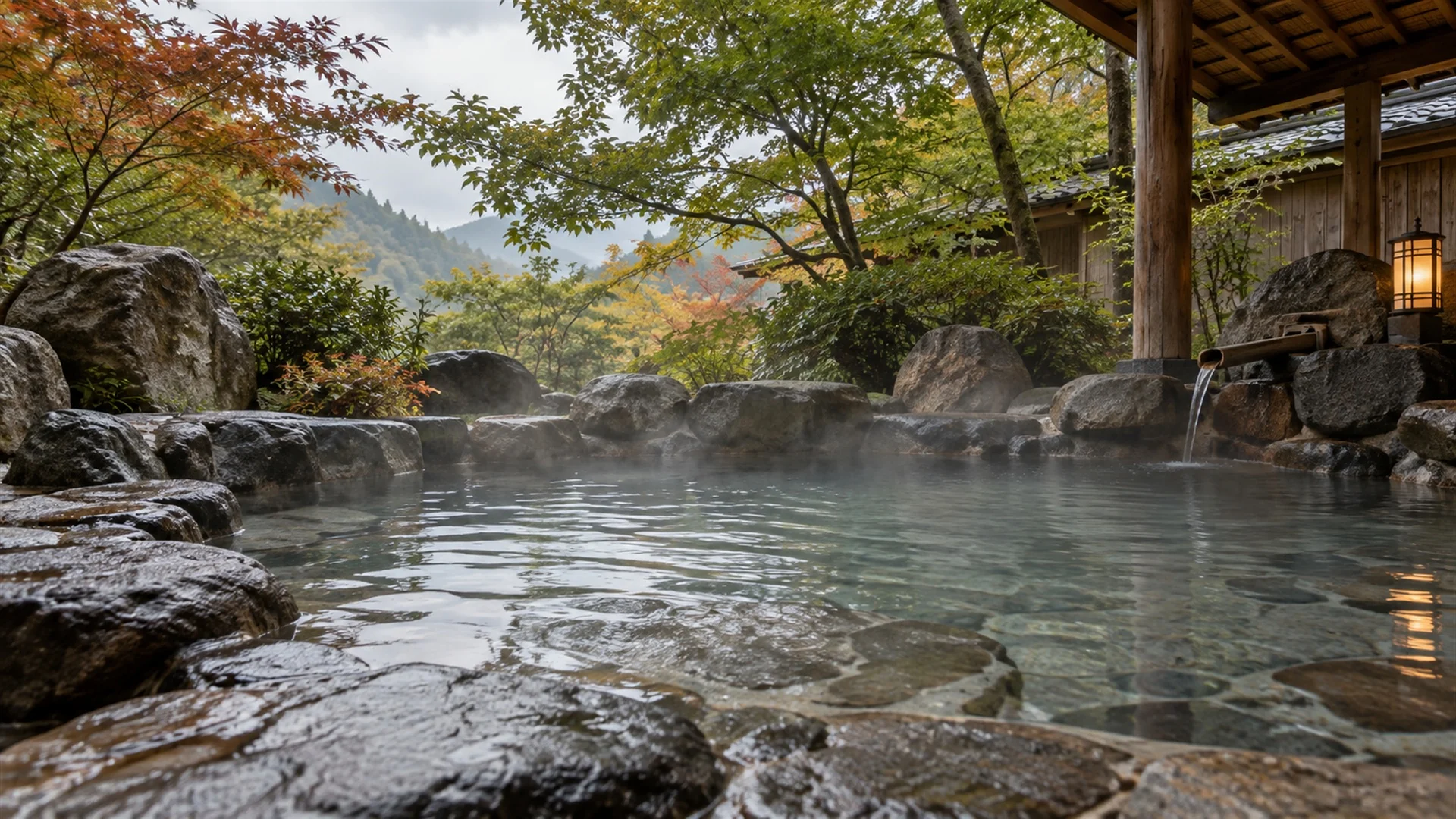
An onsen is a natural hot spring bath, and its etiquette follows a clear sequence. Bathing is nude and separated by gender, and swimwear is not worn.
- Undress in the changing room and leave clothes in the baskets provided
- Wash thoroughly first, seated at the shower stations, and rinse off all soap
- Enter slowly, keeping long hair tied up and out of the water
- Keep the small towel out of the bath, folded on the head or at the edge
- Speak softly, avoid splashing and do not swim
Tattoos deserve a direct answer. Some inns still restrict them in shared baths, while others accept small tattoos covered with a patch. Policies vary, and they should be confirmed at the time of booking.
The most reliable solution is a private bath. Many refined inns offer rooms with their own rotenburo, an open-air bath on a terrace, or private family baths that can be reserved by the hour. As a result, guests who prefer not to bathe communally can enjoy the waters in complete privacy.
After bathing, many guests skip a final rinse so that the mineral water stays on the skin. Drinking water between soaks and keeping each session short in very hot springs are simple, sensible habits.
The Kaiseki Dinner
Dinner is the centerpiece of the evening. Kaiseki is a sequence of small courses built around the season and the region, often served in the guest room or in a private dining room.
A typical progression moves from a delicate appetizer to sashimi, a clear soup, simmered and grilled dishes, and finally rice, miso soup and pickles, followed by fruit or a light sweet. Each course arrives on ceramics and lacquerware chosen to suit it.
Meanwhile, the pace is set by the kitchen. Guests are expected at the agreed time, so arriving on schedule is the only real obligation of the evening.
Dietary requirements are best shared well before arrival. Because each menu is planned in advance, most inns can adapt with notice, but rarely on the night. Understanding this rhythm is central to any Japanese ryokan and onsen guide.
Futon, Morning Bath and Breakfast
While guests are at dinner, or soon after, the attendant lays out the futon on the tatami. The low table is moved aside, and the room takes on its evening form.
Later, a final bath before sleep is common. In some inns, the men’s and women’s baths are exchanged overnight, so that guests can experience both in a single stay.
Finally, the morning begins with the quietest bath of the day, followed by a Japanese breakfast of grilled fish, rice, miso soup, tofu and small side dishes. Check-out is usually mid-morning, leaving time for an unhurried departure.
This morning routine completes the ritual described in this Japanese ryokan and onsen guide.
Where to Use This Japanese Ryokan and Onsen Guide: Hakone, Izu and Hokuriku

Geography matters as much as the inn itself. Hakone, within easy reach of Tokyo, combines hot spring valleys, lakes and, on clear days, views of Mount Fuji. It suits a first ryokan night at the start or end of a journey.
Further south, the Izu Peninsula adds the sea: coastal hot springs, rugged shorelines and dinners built around the day’s catch. In contrast, the Hokuriku region on the Sea of Japan coast pairs traditional onsen towns with the gardens and craft districts of Kanazawa.
Here, the hot spring towns of the Kaga area lie within easy reach of the city, which allows a day among Kanazawa’s gardens and teahouse districts to end with a bath and a kaiseki dinner featuring the seafood of the coast.
In Kyoto, the experience is urban rather than volcanic. Tawaraya and Hoshinoya Kyoto offer the ryokan ritual in the old capital, without natural hot springs but with exceptional hospitality. For official regional information, see https://www.japan.travel
Because of this, the best choice of region depends on the route. A well-placed ryokan night is the most rewarding application of this Japanese ryokan and onsen guide.
Warm water, quiet rooms, and a ritual worth learning
Signature Experiences
- An afternoon arrival with green tea overlooking a garden
- A first soak in an open-air rotenburo
- A seasonal kaiseki dinner served in the guest room
- Walking the inn in a cotton yukata
- A private hot spring bath on a cedar terrace
- Clear morning views of Mount Fuji from Hakone
- Coastal hot springs on the Izu Peninsula
- Craft districts and gardens of Kanazawa
- A night of refined hospitality at Tawaraya
- A dawn bath before a Japanese breakfast
Ready for Something Extraordinary?
A ryokan night is one of the most memorable experiences Japan offers, and it rewards careful selection. At EscapeXperts, we match each traveler to the right inn and region, combining seamless logistics, private experiences and curated exploration, from private baths to dietary arrangements.
Why Travel to Japan with EscapeXperts
The ryokan is a ritual with clear rules, and knowing them turns hesitation into anticipation. At EscapeXperts, we choose the inn, the room and the bath that suit each traveler, share the etiquette in advance and arrange every detail before arrival. The result is a night that fulfills everything promised by this Japanese ryokan and onsen guide.