
Duration: 2 to 3 nights
Best months: Covered in our Brazil seasonal guide
Countries: Argentina · Brazil
Region: Puerto Iguazú · Foz do Iguaçu · Iguazú National Park · Iguaçu National Park
An Iguazu Falls Travel Guide: Two Sides, Two Different Experiences
This Iguazu Falls travel guide starts with a simple point: the falls are not seen twice from two countries. They are seen in two different ways. The Argentine side brings visitors close to the water on walkways, while the Brazilian side offers the full panorama in a single walk.
Many travelers ask which side to choose. In practice, the question is how to combine them, and how much time each one deserves. Therefore, the plan depends less on borders and more on the kind of experience each side delivers.
At EscapeXperts, we treat Iguazu Falls as two complementary visits, supported by the right hotel and the right pace. For families in particular, that structure turns a demanding site into a comfortable one.
The Argentine Side: Walkways, Trains and the Devil’s Throat From Above
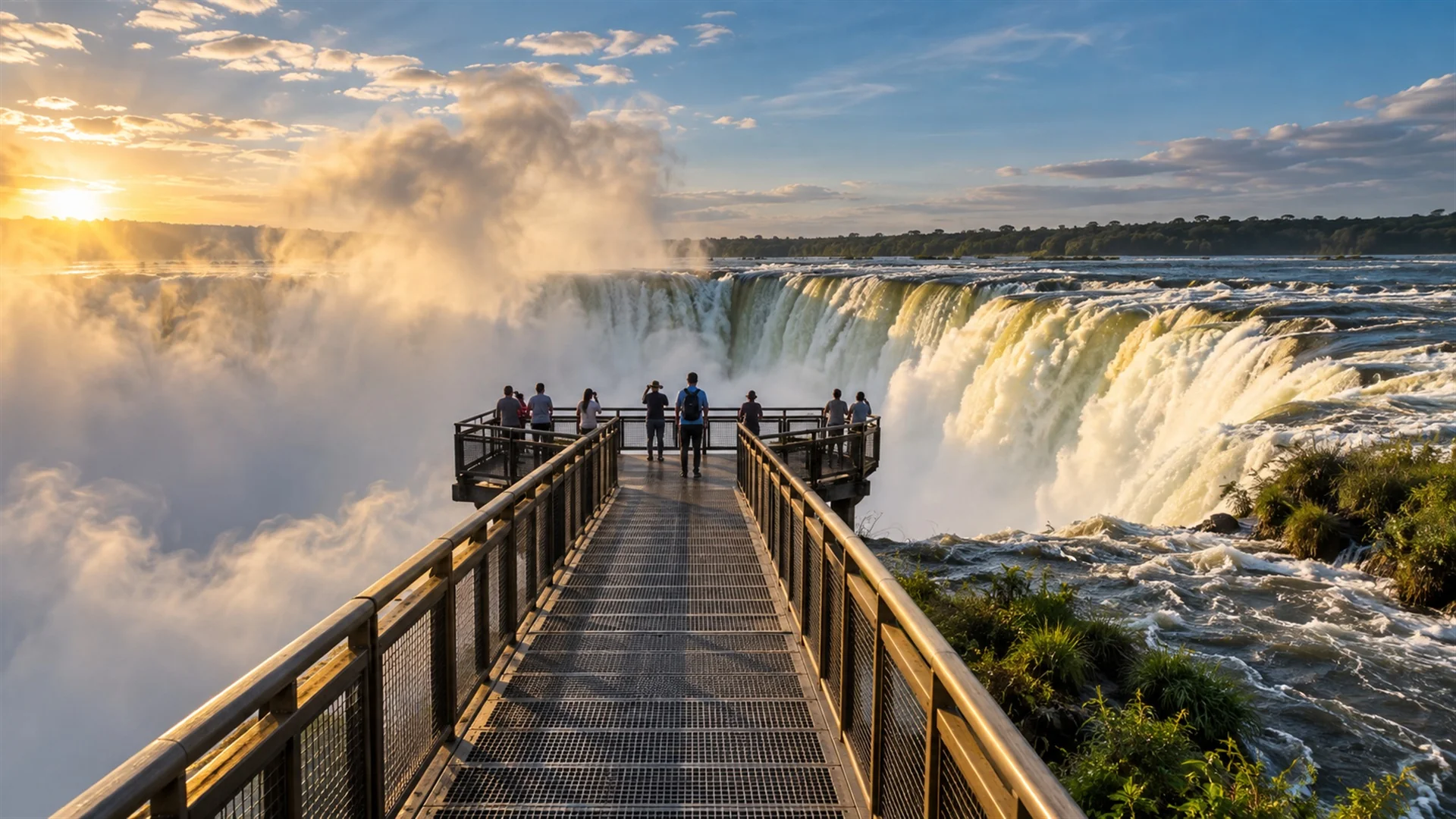
Iguazú National Park in Argentina holds most of the falls, and its design reflects that. A network of paths runs above, around and below the water, so the visit feels like moving through the falls rather than looking at them.
The park is organized into circuits. The Upper Circuit follows the top edge of several falls, with the river sliding past just beneath the rails. In contrast, the Lower Circuit descends into the forest and approaches the base of the cascades, where the spray is constant.
The highlight is the Devil’s Throat. A small rainforest train carries visitors toward it, and a long walkway then crosses the upper river to a platform at the edge of the drop. The noise, the mist and the sheer force of the water make this the most intense moment of any visit.
Because of this, the Argentine side deserves a full day. It involves more walking, but the paths are well built and suit most ages, and the train breaks the distances into manageable sections.
Here, boat excursions also approach the base of the falls. They are exhilarating, and very wet, and they work best for families with older children.
As a result, this is where the Iguazu Falls travel guide places its longest day.
The Brazilian Side: The Panorama in a Single Walk
The Brazilian side, within Iguaçu National Park, offers the view that explains the whole site. From across the gorge, the falls appear as a single sweeping front, with the forest above and the river below.
The visit follows one main trail along the canyon. It descends gradually, opening new viewpoints at every turn, and ends on a walkway that extends over the water toward the lower section of the Devil’s Throat.
Near the end of the trail, a lift returns visitors to the upper level, which keeps the walk manageable for all ages.
Meanwhile, the scale changes completely. On the Argentine side, visitors stand among the falls; on the Brazilian side, they see how the falls fit together. Both perspectives are needed to understand the place.
The Brazilian walk is much shorter, and two or three hours are usually enough. Therefore, it pairs well with a relaxed morning or afternoon rather than a full day.
This contrast is central to any Iguazu Falls travel guide: the two sides are not alternatives but complements, and the order in which they are visited shapes the experience.
Staying Inside the Parks: The Clearest Advantage

Only two hotels sit inside the national parks, one on each side. On the Brazilian side, Belmond Hotel das Cataratas occupies a pink colonial-style building a short walk from the main trail. On the Argentine side, Gran Meliá Iguazú overlooks the falls from within the park.
Their advantage is time. Guests can reach the falls straight from the hotel, early in the morning and late in the afternoon, when the paths are quiet and the light is softer.
In addition, staying inside the park removes the daily transfer from town. For families, that means fewer early starts, easier breaks and the freedom to return to the room between walks.
For younger children, the park hotels also shorten each outing. A morning walk can end with a swim and lunch, and the second visit can wait until the afternoon light.
Most other hotels are in Puerto Iguazú or Foz do Iguaçu, the two towns near the parks. They are comfortable, but they lack the early and late access that makes the park hotels exceptional.
Because of this, the choice of hotel often decides which side becomes the base of the stay, and it is the most consequential decision in any Iguazu Falls travel guide.
How Long You Actually Need
In this Iguazu Falls travel guide, two nights are the realistic minimum, and three nights give the visit its proper shape. The argument is practical rather than traditional: one full day for the Argentine side, a half day for the Brazilian side, and time in reserve.
Travelers combining Iguazu with Buenos Aires or Rio de Janeiro often try to fit the falls into a single night. That approach usually means seeing one side only, and in a hurry.
That reserve matters. Rain, mist or high water can close a walkway or a boat excursion for a few hours, and an extra half day protects the most important visits.
Next, a longer stay allows the falls to be seen at different hours. Morning light, afternoon rainbows and the quiet of early evening each change the scene.
Finally, the region offers more than the falls themselves. At the Triple Frontier, a viewpoint in Puerto Iguazú overlooks the meeting of the Iguazú and Paraná river, where Argentina, Brazil and Paraguay face one another across the water.
Crossing the Border and Getting There
Most visitors fly in from Buenos Aires or Rio de Janeiro. Each town has its own airport, and the crossing between the two sides by private transfer is short.
The border itself is a real international crossing. Passports are required, both immigration posts must be cleared, and entry requirements vary by nationality. Checking the rules for both countries before travel is essential.
From Buenos Aires, the flight to Puerto Iguazú is short, which makes the falls a natural addition to a stay in the capital. From Rio de Janeiro, the connection to Foz do Iguaçu works equally well, and many itineraries arrive on one side and leave from the other.
Private transfers handle the crossing with luggage, and a guide familiar with both parks times it to avoid the busiest hours. This is the logistical core of the Iguazu Falls travel guide.
Meanwhile, the forest brings its own residents. The coati is the most visible, often seen along the paths and around the cafés, and it should never be fed. The toucan is harder to spot, and the early morning hours offer the best chance of seeing one in the canopy.
For official visitor information, see https://www.argentina.travel
Thundering water, rainforest mist, and two views of one wonder
Signature Experiences
- The rainforest train to the Devil’s Throat
- Walkway to the edge of the drop at the Garganta del Diablo
- Upper and Lower Circuits in Iguazú National Park
- A boat approach to the base of the falls
- The panoramic canyon trail in Iguaçu National Park
- Early morning walk from Belmond Hotel das Cataratas
- Falls views from Gran Meliá Iguazú
- Afternoon rainbows over the gorge
- Sunset at the Triple Frontier viewpoint
- Spotting toucans and coatis along the forest paths
Ready for Something Extraordinary?
Iguazu rewards careful planning more than almost any natural site. At EscapeXperts, we arrange the hotel, the border crossing and the timing of each visit, combining seamless logistics, private guiding and curated exploration on both sides.
Why Travel to Iguazu Falls with EscapeXperts
At Iguazu, the difference between a rushed visit and a memorable one lies in time and place. At EscapeXperts, we combine both sides of the falls, secure stays inside the parks and set a pace that suits every member of the family, so that this Iguazu Falls travel guide becomes a journey rather than a checklist.