Best months: July to October, the heart of the dry season
Country: Brazil
Gateway: Cuiabá, Mato Grosso
Region: Northern Pantanal · Transpantaneira · Porto Jofre · Cuiabá river
A Pantanal Wildlife Safari for Travelers Who Know Africa
A Pantanal wildlife safari offers what few travelers expect from South America: a realistic chance of watching a wild jaguar at close range. In the dry season, water retreats into rivers and ponds across Brazil’s great wetland, and the wildlife gathers where the water remains.
Many seasoned safari travelers know the savannas of Africa well yet have never heard of the Pantanal. It is the world’s largest tropical wetland, spreading across the Brazilian states of Mato Grosso and Mato Grosso do Sul and into neighboring Bolivia and Paraguay.
At EscapeXperts, we present it as the great wildlife destination of the Americas. The following guide explains the seasonal logic behind it, and why a jaguar sighting here is a genuine likelihood rather than a hope.
A Wetland Governed by Water
Everything in the Pantanal follows the annual rise and fall of the water. During the wet season, roughly from November to March, rain and river overflow submerge much of the floodplain. Animals disperse across a vast area, and many roads and trails become impassable.
Then the pattern reverses. As the dry season advances from mid-year, the water drains away and remains only in rivers, channels and shrinking ponds. Fish become concentrated, and the birds, caimans and mammals that depend on them concentrate as well.
As a result, July to October is the period when a Pantanal wildlife safari reaches its peak. Visibility is at its best, animals congregate along the water’s edge, and the riverbanks become natural stages for wildlife viewing.
The conservation value of the region is internationally recognized. Part of the wetland is protected as a World Heritage site, described in detail here: https://whc.unesco.org/en/list/999
Along the Transpantaneira
Most journeys into the northern Pantanal begin in Cuiabá, the capital of Mato Grosso. From there, a drive of a few hours leads to the start of the Transpantaneira, a raised dirt road that runs south into the wetland for roughly 150 kilometers.
The road itself is a wildlife corridor. It crosses dozens of wooden bridges over channels and lagoons, where caiman lie along the banks and herons, storks and kingfishers fish in the shallows. Meanwhile, families of capybara, the world’s largest rodent, graze at the water’s edge.
Lodges along the road range from converted cattle ranches to comfortable riverside retreats. They offer early morning walks, horseback outings across the open fields and night drives in search of nocturnal species.
Because of this, the first days of a Pantanal wildlife safari are often spent along the Transpantaneira. The pace is unhurried, the birdlife is abundant, and the landscape prepares travelers for the rivers further south.
Jaguars by Boat from Porto Jofre
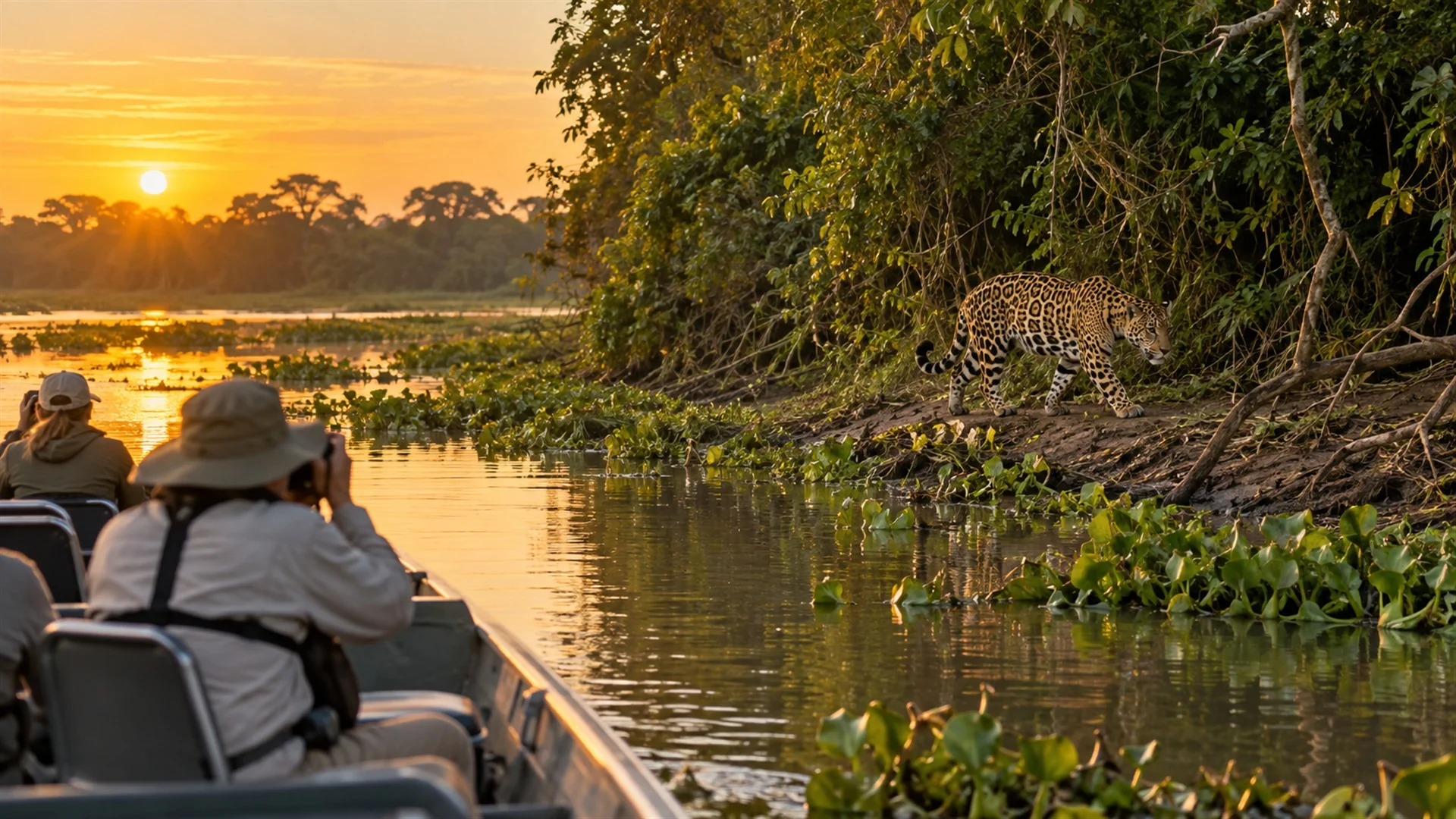
The Transpantaneira ends at Porto Jofre, on the banks of the Cuiabá river. This is the center of jaguar observation in the northern Pantanal, and the reason many travelers make the journey.
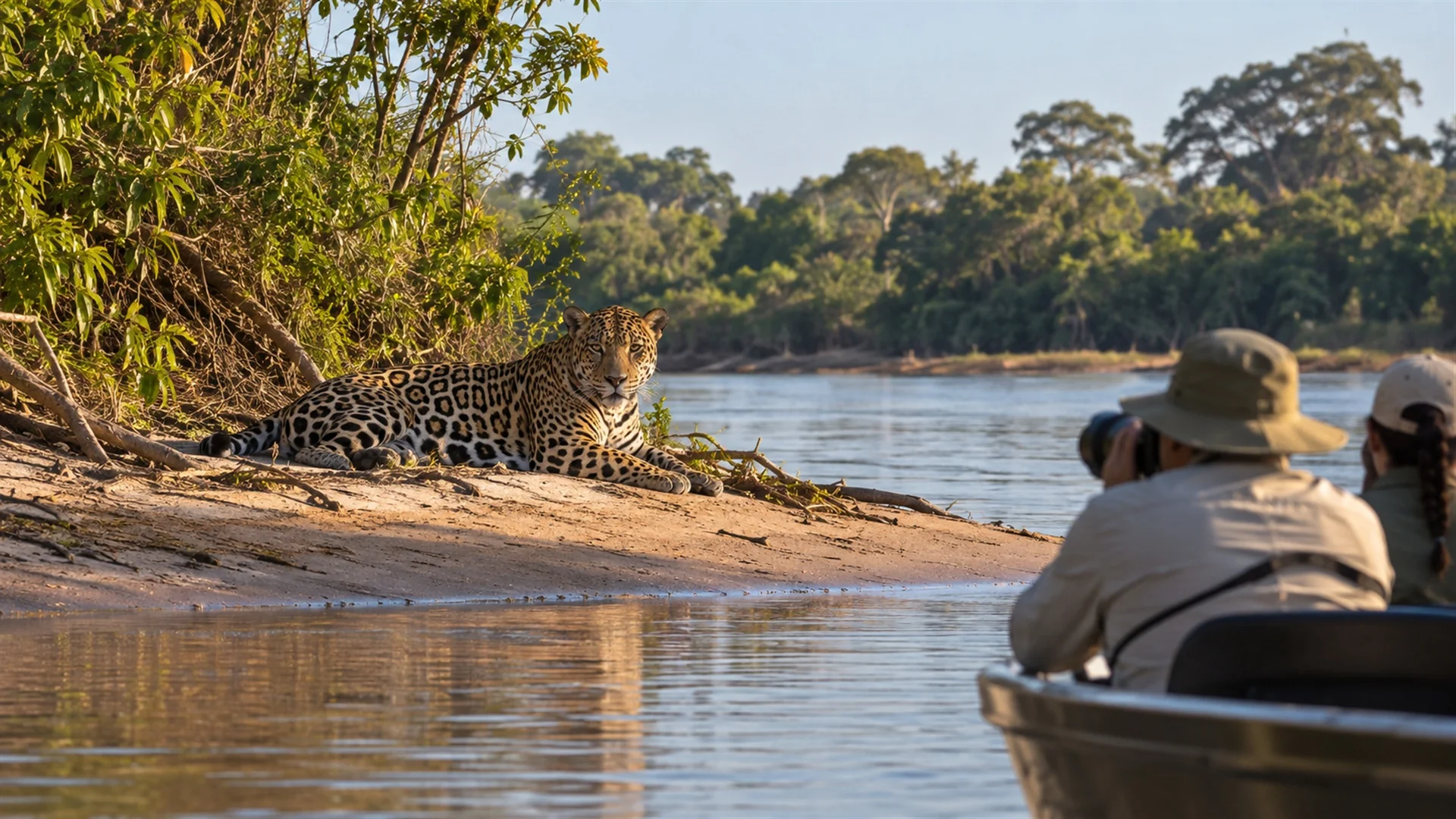
Here, the safari format changes. Instead of vehicles on open plains, small boats with experienced guides explore the Cuiabá river and its tributaries. Jaguars patrol the riverbanks, rest in the shade, and hunt caiman and capybara along the water’s edge.
In the dry season, the combination of low water and dense river corridors creates favorable conditions for sightings. Guides share information by radio, and boats move quietly to keep a respectful distance. The Pantanal jaguar is among the largest of its species, and watching one swim across a river is unforgettable.
Nevertheless, sightings are never guaranteed. Wildlife moves on its own terms, and patience is part of the experience. Several days on the river significantly improve the odds, which is why a Pantanal wildlife safari typically allows three or four nights in the Porto Jofre area.
Giant Otters, Macaws and the Wider Cast
The jaguar is only one part of the story. The rivers around Porto Jofre are also home to the giant otter, which lives in noisy family groups and fishes cooperatively. Their calls often announce them long before they appear.
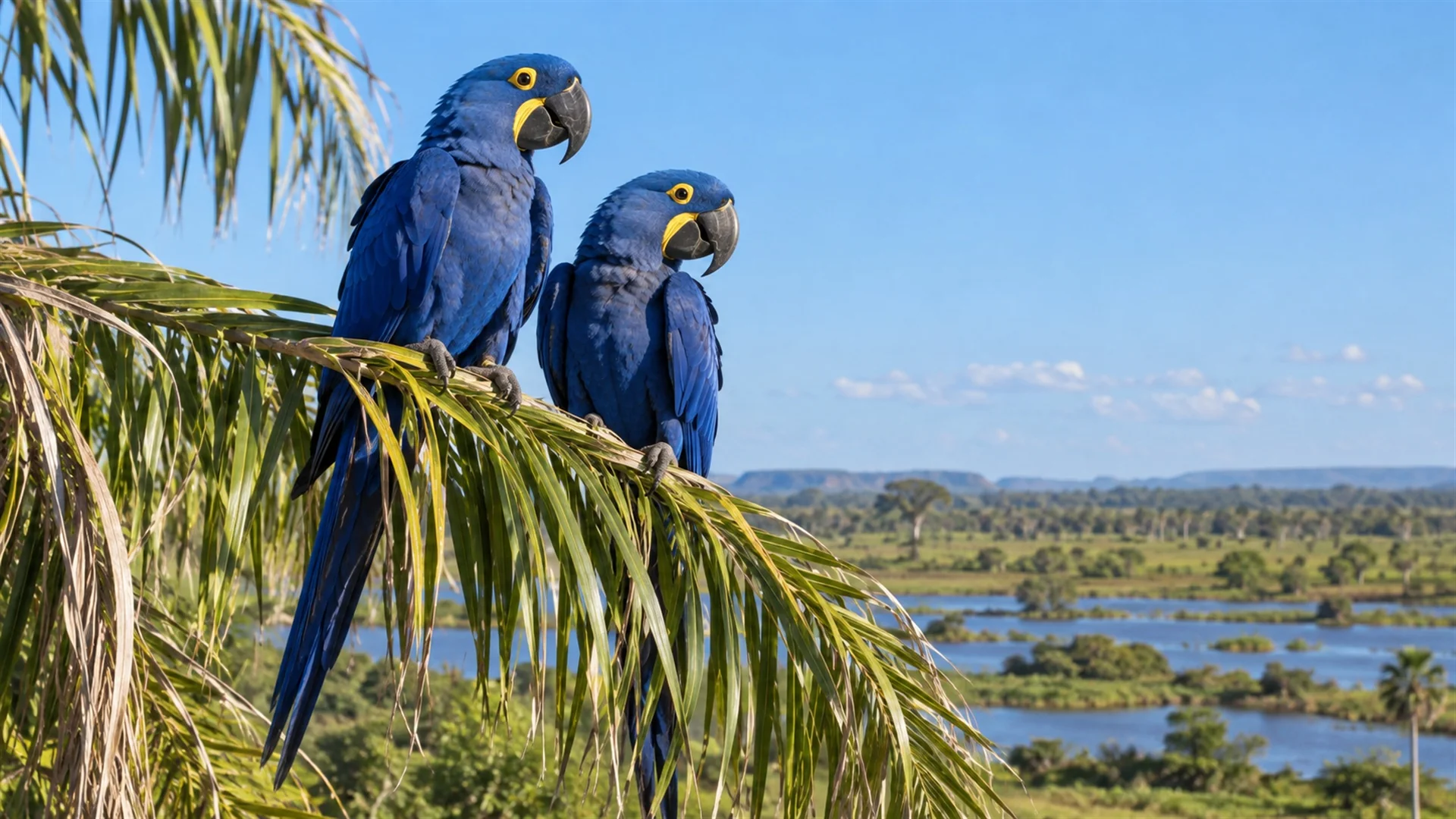
In addition, the hyacinth macaw, the largest flying parrot in the world, nests in the palm groves of the wetland. Its cobalt plumage and loud calls make it one of the most striking sights of the region.
Birdlife is exceptional throughout the year. The jabiru stork, symbol of the Pantanal, wades through the shallows, while toucans, egrets and raptors fill the sky. Meanwhile, patient observers may encounter giant anteaters, tapirs or ocelots, especially during night drives.
Therefore, the Pantanal rewards travelers who enjoy the whole ecosystem, not only one species. Each day brings new encounters and a different perspective on the wetland.
The Rhythm of a Day on the River
For travelers used to African game drives, the structure of the day will feel familiar. Activity concentrates in the cooler hours, and the middle of the day is for rest. The difference lies in the vehicle: here, the boat takes the place of the open safari truck.
Mornings start early, with departures shortly after first light when the river is calm and the animals are active. Boats return to the lodge before the midday heat, which in the dry season can be intense on open water. Next, a second outing in the late afternoon follows the river until the light fades.
A private boat with a dedicated guide changes the experience considerably. It allows longer waits at a promising stretch of bank, a quieter approach and a pace set entirely by the wildlife rather than by a group schedule.
Practical preparation matters as well. Neutral clothing, strong sun protection, good binoculars and a long camera lens are essential. Because of this, a well-planned Pantanal wildlife safari usually spans six or seven nights, divided between the Transpantaneira and the rivers around Porto Jofre.
Pantanal and Amazon: Two Different Propositions
The Pantanal is often confused with the Amazon, but the two offer very different experiences. The Amazon is a dense rainforest, where the canopy hides much of the wildlife and sightings depend on sound, patience and luck.
In contrast, the Pantanal is largely open. Its floodplains, grasslands and gallery forests allow clear views across long distances. Animals are visible along riverbanks and open fields, which explains why wildlife encounters here are so frequent.
For wildlife observation, the difference is decisive. The Amazon offers biodiversity and immersion in the forest, while the Pantanal delivers visibility and concentrated sightings, particularly in the dry season.
Finally, the Pantanal pairs well with a southern extension. Properties such as the Caiman Ecological Refuge in Mato Grosso do Sul add a ranch-based experience and jaguar conservation work to a Pantanal wildlife safari.
Open wetlands, quiet rivers, and the rhythm of the wild
Signature Experiences
- Private arrival in Cuiabá and transfer into the wetland
- Wildlife drive along the Transpantaneira and its wooden bridges
- Boat safaris on the Cuiabá river in search of jaguars
- Several days of river exploration around Porto Jofre
- Encounters with families of giant otter along quiet channels
- Sightings of hyacinth macaw in palm groves
- Dawn walks among capybara and caiman at the water’s edge
- Night drives in search of anteaters, tapirs and ocelots
- Horseback outings across open grasslands of Mato Grosso
- Birdwatching for jabiru storks and toucans throughout the day
Ready for Something Extraordinary?
A journey to the Pantanal requires timing and precise planning. At EscapeXperts, we combine seamless logistics, expert guiding and private experiences to create a safari that follows the rhythm of the wetland and its wildlife.
Why Travel to the Pantanal with EscapeXperts
The Pantanal remains one of the most rewarding wildlife destinations in the Americas, yet few travelers know it well. At EscapeXperts, we align the season, the lodges and the river days so that every hour on the water counts. The result is a Pantanal wildlife safari that combines comfort, expert guidance and genuine encounters with the wild.