Suggested stay: 7 to 9 nights
Best months: June to September
Country: Ecuador
Region: Quito · Imbabura · Cotopaxi · Chimborazo
Quito and the Ecuadorian Andes, Beyond the Airport Transfer
Quito and the Ecuadorian Andes form one of the most rewarding highland journeys in South America. The capital holds one of the best-preserved colonial centers in the Americas, and beyond it a corridor of volcanoes, market towns and historic haciendas stretches north and south along the spine of the country.
Many travelers see Quito only as a place to change planes. As a result, they miss a city of gilded churches and quiet cloisters, and a countryside where centuries-old estates now welcome guests.
At EscapeXperts, we treat the highlands as a destination in their own right. The route moves at a measured pace, with comfortable stays, private guides and time built in for the altitude.
The route suits active travelers who value comfort as much as discovery. Distances are modest, the roads between the main stops are good, and most days involve only a few hours of travel, followed by an afternoon at a historic estate.
Quito’s Colonial Core at 2,850 Meters
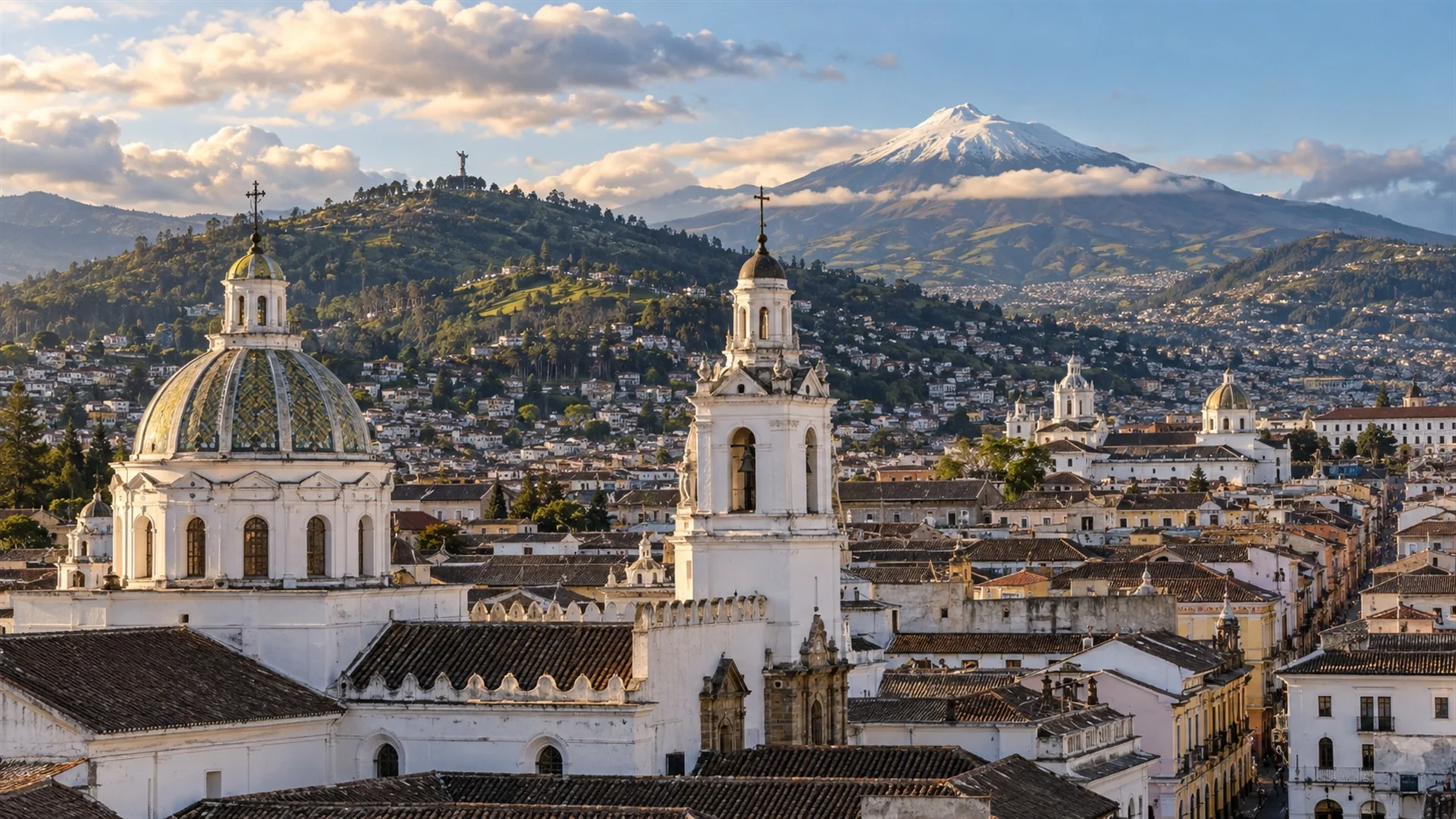
Quito sits at around 2,850 meters above sea level, and the altitude is noticeable on arrival. Therefore, the first day is kept deliberately light, with a slow walk, plenty of water and an early dinner. Most travelers adjust gradually over the first days, and the itinerary is sequenced so that higher ground comes later.
The Quito Old Town rewards that patience. Its historic center was among the first places inscribed on the UNESCO World Heritage List, and the grid of plazas, churches and convents remains remarkably intact.
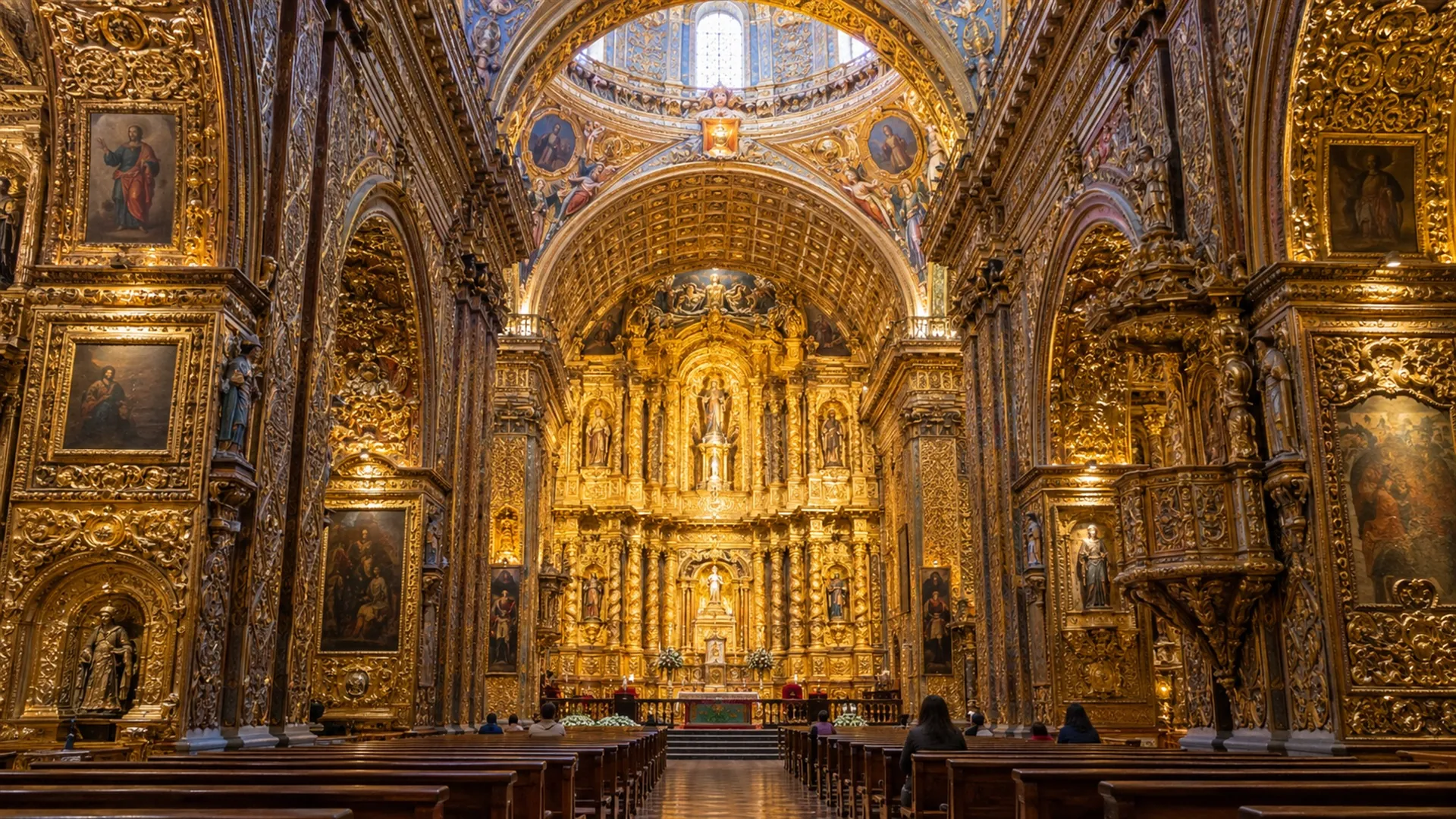
The church of La Compañía de Jesús is the most striking interior. Built by the Jesuits over more than a century and a half, its nave, altars and pulpit are covered in carved wood and gold leaf. Nearby, the monastery of San Francisco opens onto a broad cobbled plaza and holds one of the largest colonial religious complexes on the continent.
In addition, the Plaza Grande gathers the cathedral, the presidential palace and the archbishop’s palace around a single shaded square. A short walk away, the neo-Gothic Basílica del Voto Nacional replaces conventional gargoyles with carved condors, armadillos and iguanas.
Beyond the major churches, smaller museums and cloisters reward slower visits. The cloisters of San Francisco and the Museo de la Ciudad reveal the workshops of the Quito School, the colonial tradition of religious painting and sculpture that shaped churches across the region.
Here, Casa Gangotena, a restored mansion on Plaza San Francisco, makes an ideal base. Evenings along La Ronda, the old lantern-lit street below the center, complete the first chapter of Quito and the Ecuadorian Andes.
North to Otavalo and Hacienda Zuleta
Next, the journey heads north through the province of Imbabura, a landscape of lakes, farmland and volcanic peaks. Just north of the city, the Mitad del Mundo monument marks the equator line, a brief and optional stop rather than a destination in itself.
The market town of Otavalo is known for its Kichwa weaving tradition. The Plaza de los Ponchos fills with textiles, woolens and embroidered goods, and Saturday is traditionally the busiest day. A private guide helps distinguish local craftsmanship from imported goods.
Nearby, the crater lake of Cuicocha lies at the foot of Cotacachi volcano, with a walking path along part of the rim. The neighboring town of Cotacachi is known for its leatherwork.
Meanwhile, the Andean haciendas offer a distinctive way to stay. These historic estates were once centers of large agricultural holdings, and several now receive guests in their original houses, with fireplaces, gardens and home-grown produce at the table.
Hacienda Zuleta, about two hours north of Quito, is among the best known. The working estate produces its own dairy and cheeses, supports local embroidery, and runs a condor conservation project. Horseback rides lead across the surrounding valleys at an easy pace.
Because of this, the northern highlands introduce the hacienda route that defines Quito and the Ecuadorian Andes: rural, unhurried and deeply rooted in place.
The Avenue of the Volcanoes: Cotopaxi and Chimborazo
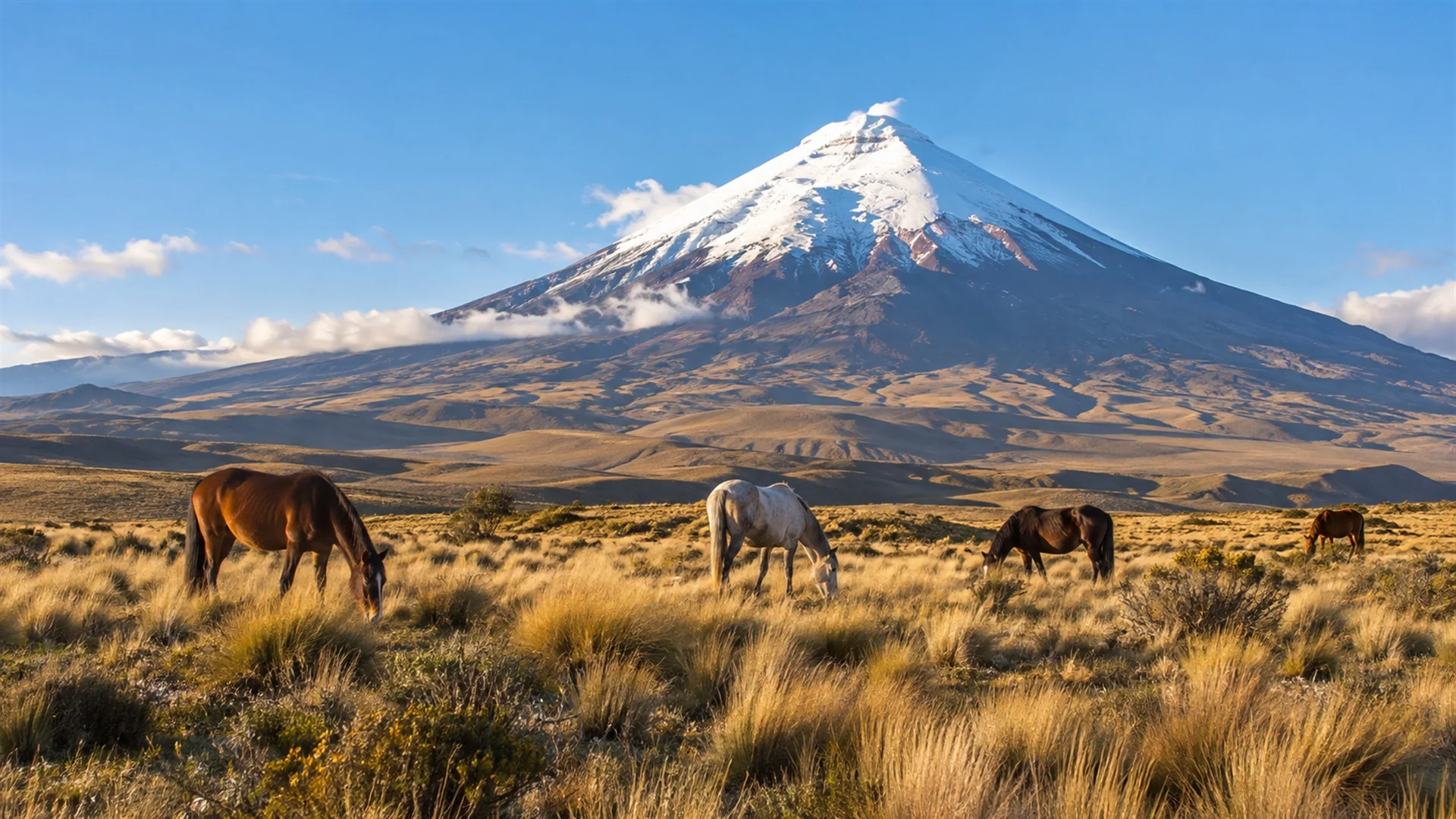
South of Quito, the Pan-American Highway runs through a valley flanked by volcanoes on both sides. This corridor is known as the Avenue of the Volcanoes, a name often credited to the naturalist Alexander von Humboldt.
Cotopaxi is its most recognizable peak, a near-perfect snow-capped cone and one of the highest active volcanoes in the world. The national park that surrounds it offers open grassland, lagoons and wild horses, with guided walks adapted to each traveler. Mornings are usually the clearest time to see the peaks, as cloud tends to build in the afternoon.
Further south, Chimborazo is the highest mountain in Ecuador. Because the Earth bulges at the equator, its summit is the point on the planet’s surface farthest from its center, a distinction that makes it more than a scenic backdrop. The reserve around the mountain is also home to vicuñas, reintroduced to Ecuador in the late twentieth century, which graze the high sandy plains.
Several haciendas sit along this corridor. Hacienda San Agustín de Callo, near Cotopaxi, preserves walls built by the Inca, and serves as a comfortable base for exploring the park.
Later, travelers with good acclimatization can drive higher toward the refuges on the volcano slopes. As a result, the most demanding altitudes are reached only after several days in the highlands, which is the safest sequence for Quito and the Ecuadorian Andes.
Quilotoa, Papallacta and the High Páramo
West of the volcano corridor, Quilotoa is a water-filled caldera whose lake shifts between green and turquoise depending on the light. The rim sits close to 4,000 meters, so a short walk along the edge is usually enough to appreciate the scale.
The highland communities around the crater are also associated with Tigua painting, a folk art tradition of brightly colored village scenes painted on sheepskin.
In contrast, the eastern side of the Andes offers restoration. Papallacta, a short drive from Quito on the road toward the Amazon basin, is known for its thermal springs, set in a valley of mist and highland vegetation. A soak in the hot pools is a gentle way to close a day at altitude, and it fits neatly into the final day before the flight home.
Both excursions cross the páramo, the high-altitude grassland that covers much of the Ecuadorian Andes above the tree line. Its cushion plants, tussock grasses and wetlands play an important role in supplying water to the valleys below.
Finally, the journey returns to Quito for a last evening in the old town. Official travel information for the highlands is available at https://ecuador.travel
This closing stage brings together landscape, comfort and culture, the three threads of Quito and the Ecuadorian Andes.
Gilded churches, volcanic horizons, and the quiet life of the haciendas
Signature Experiences
- Private walking tour of the Quito Old Town
- Gilded interior of La Compañía de Jesús
- Stay at Casa Gangotena on Plaza San Francisco
- Evening stroll along lantern-lit La Ronda
- Textile browsing in the markets of Otavalo
- Hacienda life and horseback rides at Hacienda Zuleta
- Drive along the Avenue of the Volcanoes
- Guided walks in Cotopaxi National Park
- Views of Chimborazo, Ecuador’s highest peak
- Crater lake panoramas at Quilotoa
- Thermal springs at Papallacta
Ready for Something Extraordinary?
Highland Ecuador deserves more than a night between flights. At EscapeXperts, we design journeys with careful pacing for altitude, seamless logistics and private experiences in historic haciendas and colonial Quito.
Why Travel to Quito and the Andes with EscapeXperts
The Ecuadorian highlands combine colonial heritage, volcanic landscapes and a living hacienda tradition within a few hours of the capital. At EscapeXperts, we plan the sequence around altitude, select historic stays and arrange private guides throughout. The result is a journey through Quito and the Ecuadorian Andes that feels comfortable, cultured and quietly remarkable.